
Effects of Soil Moisture and Excavator Size on Soil Structural Quality Response to Mechanical Site Preparation: A Case Study on Silty-Loam Soils in France
doi: https://doi.org/10.5552/crojfe.2026.4045
volume: issue, issue:
pp: 13
- Author(s):
-
- Collet Catherine
- Agro Chloé
- Akroume Emila
- Puyal Malaurie
- Vast Florian
- Article category:
- Original scientific paper
- Keywords:
- visual soil estimation, cultivation profile, soil trafficability, soil workability
Abstract
HTML
Mechanical site preparation (MSP) is widely performed around the globe to enhance the success of forest plantations. However, MSP can cause severe soil disturbance whose magnitude depends on various factors such as soil characteristics, soil moisture conditions and the type of machinery. In an experiment conducted in Northeastern France, we analyzed the combined effects of machine size and soil water content on the soil structural quality following MSP performed with subsoilers mounted on excavators. MSP was carried out at two dates with different soil moisture contents (average soil moisture content at 10 cm depth: 40–54% during the wet period, 32–34% during the dry period), using two excavators that differed in weight (2.7 T and 9 T) and engine power, in two forest stands that differed in their soil characteristics (a sandy loam and a clay loam) and that both showed compacted soils. We used a profile wall method (i.e. a visual soil estimation method) to describe the soil structural quality, 2 to 6 months after MSP was performed. All instances of MSP resulted in an increase in the volume of soil favorable to root growth, i.e., soil with a friable structure, compared to the unprepared control (+60%). No evidence of soil degradation due to MSP (compaction, smearing, puddling, voids) was found in comparison to the unprepared control. The larger excavator prepared the soil to a greater depth due to its larger MSP tool and its higher engine capacity (depth of 40 and 53 cm, for the small and large excavator, respectively). MSP performed during the dry period resulted in a greater volume of soil favorable to root growth than MSP performed during the wet period (+60%). Our results indicate that MSP provides better results when conducted during the dry period. Therefore, it is strongly recommended that forest operators carefully consider the timing of MSP operations and prioritize dry soil conditions to execute them.
Effects of Soil Moisture and Excavator Size on Soil Structural Quality Response to Mechanical Site Preparation: A Case Study on Silty-Loam Soils in France
Catherine Collet, Chloé Agro, Emila Akroume, Malaurie Puyal, Florian Vast
https://doi.org/10.5552/crojfe.2026.4045
Abstract
Mechanical site preparation (MSP) is widely performed around the globe to enhance the success of forest plantations. However, MSP can cause severe soil disturbance whose magnitude depends on various factors such as soil characteristics, soil moisture conditions and the type of machinery. In an experiment conducted in Northeastern France, we analyzed the combined effects of machine size and soil water content on the soil structural quality following MSP performed with subsoilers mounted on excavators. MSP was carried out at two dates with different soil moisture contents (average soil moisture content at 10 cm depth: 40–54% during the wet period, 32–34% during the dry period), using two excavators that differed in weight (2.7 T and 9 T) and engine power, in two forest stands that differed in their soil characteristics (a sandy loam and a clay loam) and that both showed compacted soils. We used a profile wall method (i.e. a visual soil estimation method) to describe the soil structural quality, 2 to 6 months after MSP was performed. All instances of MSP resulted in an increase in the volume of soil favorable to root growth, i.e., soil with a friable structure, compared to the unprepared control (+60%). No evidence of soil degradation due to MSP (compaction, smearing, puddling, voids) was found in comparison to the unprepared control. The larger excavator prepared the soil to a greater depth due to its larger MSP tool and its higher engine capacity (depth of 40 and 53 cm, for the small and large excavator, respectively). MSP performed during the dry period resulted in a greater volume of soil favorable to root growth than MSP performed during the wet period (+60%). Our results indicate that MSP provides better results when conducted during the dry period. Therefore, it is strongly recommended that forest operators carefully consider the timing of MSP operations and prioritize dry soil conditions to execute them.
Keywords: visual soil estimation, cultivation profile, soil trafficability, soil workability
1. Introduction
Mechanical site preparation (MSP) plays an important role in the establishment of plantation forestry. Its primary purpose is to control the vegetation that may potentially compete with the young tree seedlings, enhance the soil structure and water availability, reduce biotic damage, and, ultimately, improve the success of the plantation (Löf et al. 2012). Additionally, MSP contributes to greater labor efficiency and reduces heavy manual work (McEwan and Steenkamp 2015). However, MSP can cause severe soil disturbance that may have long-lasting effects (Sutinen et al. 2010) and that may negatively impact various functions within the forest ecosystem (Labelle et al. 2022, Varnagirytė-Kabašinskienė et al. 2022). Forest stakeholders are becoming increasingly aware of the importance of implementing sustainable soil management practices. Nevertheless, the available information regarding the impacts of MSP on forest soil structure is currently limited, impeding the development of silvicultural techniques for forest plantation aimed at maintaining long-term soil fertility.
The soil quality produced by MSP is influenced by various factors, including soil characteristics, operational conditions (weather conditions, soil moisture), the choice of machinery (prime mover and tool), the type of MSP performed (subsoiling, mounding, inverting) and the experience of the machine operator (Müller et al. 2011, Labelle et al. 2022). The concepts of soil trafficability and soil workability are useful for assessing the opportunities for forest machinery to access the stand and carry out MSP before planting (Rounsevell and Jones 1993). Trafficability refers to the ability of the soil to support vehicle traffic without causing soil compaction (i.e. increase in bulk density) or deformation (i.e. changes in structure), and workability refers to the capacity of the soil to provide favorable conditions for seedling development after MSP, without generating soil compaction or deformation (Edwards et al. 2016).
The issue of trafficability in mechanized forest harvesting operations has been extensively researched (Mariotti et al. 2020, Nazari et al. 2021). Strategies aimed at minimizing soil degradation during logging operations include reducing the machine load and the contact pressure between machines and soil, and waiting for relatively dry soil conditions when the load-bearing capacity of the soil is greater (Cambi et al. 2015, Hoffmann et al. 2022, Latterini et al. 2024). These general guidelines also apply to MSP prior to planting. However, MSP typically involves the use of much smaller machines, different traction types and different tire and track equipment compared to harvesting operations. Consequently, quantitative decision support systems that were developed for logging operations to estimate the temporal opportunities that would optimize trafficability may not be applicable to MSP.
To the best of our knowledge, studies dealing with forest MSP workability are rare, and our comprehension of soil workability is primarily derived from field crop research (Müller et al. 2011). Workability depends on the operator and machinery, as well as the various responses to tillage of different soil types and soil water status (Rounsevell and Jones 1993). For a given soil, workability is predominantly restrained by excessively wet or excessively dry soil conditions (Dexter and Bird 2001, Obour et al. 2017). Performing MSP when soil is too wet can lead to structural damage due to compaction, smearing (creation of a thin but highly compacted layer at the soil-tool interface) or puddling (production of mud resulting from mixing soil and water). Executing MSP when soil is too dry can lead to excessive cloddiness (creation of large clods) since soil aggregates become stronger and more difficult to break when the soil dries. In addition, the characteristics of machinery, including but not limited to engine power, tool shape and size, significantly affect soil workability, with their impact potentially interacting with soil moisture content: for instance, a small machine possessing a limited engine capacity may struggle to effectively prepare dry soils; conversely, larger machines, equipped with large tools typically attain deeper and more water-saturated soil layers which may exhibit increased susceptibility to structural damage. The relationship between soil trafficability and soil water status is contingent upon the specific equipment utilized.
Trafficability and workability are both dependent on the soil moisture regime, soil properties, the machinery employed and the specific type of MSP conducted (such as surface scarification, plowing or deep subsoiling). For a given type of machinery and MSP, optimum soil states for both trafficability and workability do not coincide (Müller et al. 2011) and, finally, the timeframe during which favorable soil conditions are achieved may be limited.
These concepts have been widely used in field crop research to design decision support systems to perform soil tillage operations. In forestry, our comprehension regarding trafficability and workability for MSP prior to planting is extremely limited, and the effects of soil moisture conditions as well as the effects of the machinery employed on the structural quality of soil following MSP have not been properly characterized. This gap in our understanding impedes our capacity to provide guidelines to ensure the timely execution of MSP in order to obtain the best outcomes.
Therefore, to address this gap and improve guidelines for timely MSP execution, we analyzed the combined effects of machine size and soil water content on soil morphology and structural quality (color, hydromorphy, organic matter, traces of animal activity and plant roots, clod structure and spatial arrangement) following MSP performed prior to planting. MSP was carried out at two dates with different soil moisture contents, using two types of equipment (MSP tools mounted on two excavators that differed in weight and engine power). The study was performed in two experimental sites that differed in their soil characteristics and that were located in a forest in Northeastern France. We used the cultivation profile method (a profile wall method) to describe the soil structural quality after MSP. We expected that:
- MSP performed under wet conditions would lead to a smaller volume of soil favorable to root growth (i.e. soil with a less friable structure)
- large machinery would lead to larger volume of soil favorable to root growth, created the displacement of a large tool within the soil and, simultaneously, to more visible soil degradation attributable to the use of a heavy machine.
2. Material and Methods
2.1 Study Sites
The two experimental sites were located in Northeastern France (coordinates to the nearest degree: 48°N, 6°E) and were 500 m apart. Elevation was 480 m, annual minimum and maximum temperature were 5.2 and 14.6°C, respectively, and annual rainfall averaged 917 mm (Météo-France).
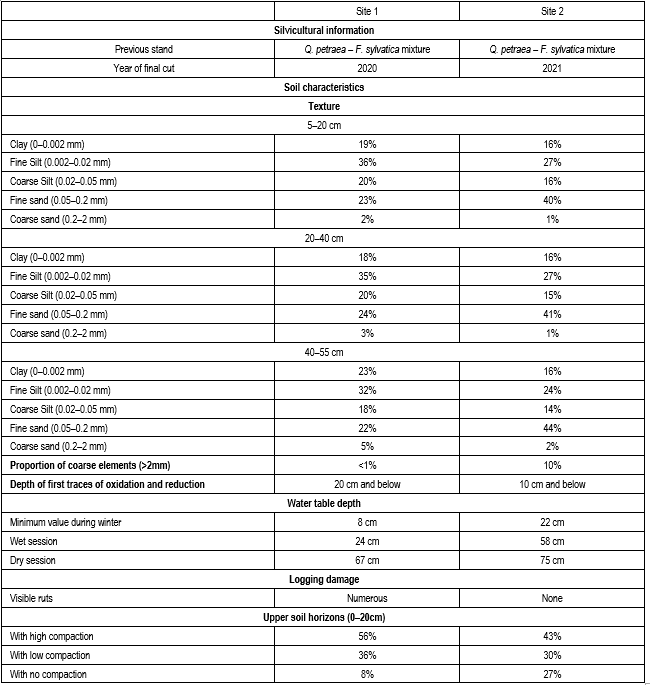
Former stand types were naturally regenerated broadleaved mixtures that had been cut during spring 2020 or during spring 2021 (Table 1). We used a hand auger to describe soil vertical profiles. Site 1 was located on a silty-loam soil and Site 2 on a loam soil. Signs of hydromorphism (gray-blue discoloration and reddish patches) appeared at a depth of 20 and 10 cm at Sites 1 and 2, respectively. We quantified the load of coarse elements (>2 mm) in trench profiles: less than 1% at Site 1 and 10% at Site 2. Nine manually-read piezometers were installed at each site. Water table depth was recorded every other week, from May 2021 to August 2022. During the winter season (November 2021 – March 2022), water table depth ranged between 8 and 26 cm at Site 1, and between 22 and 65 cm at Site 2. We used a spade method (Turillon et al. 2018) to estimate the compaction of the upper (0–20 cm) soil horizon. On March 7, 2022 and on July 4, 2022, we sampled 24 locations at each site and each date (96 locations in total). Approximately half of the samples were highly compacted at both sites (i.e. samples show large clods with sharp edges), and only 8% and 27% of the samples showed no compaction (i.e. samples show small aggregates with soft edges) at Sites 1 and 2, respectively. On April 27, soil samples were taken with an auger at three depths (5–15 cm, 25–35 cm, 45–55 cm) at 12 locations at each site. The samples of different locations were pooled and a granulometric analysis was performed on each of the six pooled samples (3 depths x 2 sites).
Table 1 Site description: silvicultural operations performed and soil characteristics
2.2 MSP Treatments
We performed MSP treatments at two periods that differed in the level of soil moisture. At the beginning of each period, we measured soil water depth and gravimetric soil water content. Soil samples were collected with an auger at three depths (10, 30, 50 cm) and their fresh and oven-dry weights were measured and used to compute moisture content. The two periods were:
- wet period (March 7–10, 2022). Average soil moisture content was 40, 29 and 25% at 10, 30 and 50 cm in depth at Site 1, and 54, 31, 27% at Site 2. Water table depth was 24 and 58 cm at Sites 1 and 2, respectively
- dry period (July 4–8, 2022). Average soil moisture content was 34, 23 and 22% at 10, 30 and 50 cm in depth at Site 1, and 32, 24 and 19% at Site 2. Water table depth was 67 and 75 cm at Sites 1 and 2, respectively.
Two MSP treatments were applied at both sites and during both periods, which mainly differ in the dimension of the equipment (tool and machine) used (Fig. 1):
- small equipment: We used a subsoiler (standard model, Sous-soleur Multifonction®, Kirpy). The tool consists of two parts: a 100 cm wide rake on the top of the tool to clear away debris, and a 57 cm high curved tine with two 14 cm long lateral wings and a 55 cm long pointed tip to provide deep soil fracture and to form a mound. The tool was mounted on a Doosan DX27Z: a 2.7-T and 1.55 m wide excavator with a 15.4 kW/21 hp engine and rubber tracks (width: 0.3 m; length: 1.95 m; static pressure: 0.28 kg cm -2 ).
- large equipment: We used a subsoiler (Modul’D model, Sous-soleur Multifonction®, Kirpy). The tool consists of two parts: a 105 cm wide rake on the top of the tool to clear away debris, and a 68 cm high curved tine with two 18 cm long lateral wings and an 83 cm long pointed tip to provide deep soil fracture and to form a mound. The tool was mounted on a Caterpillar CAT 308 CR: a 9-T and 2.28 m wide excavator with a 55.4 kW/75 hp engine and rubber tracks (width: 0.45 m; length: 2.92 m; static pressure: 0.40 kg cm -2 ).
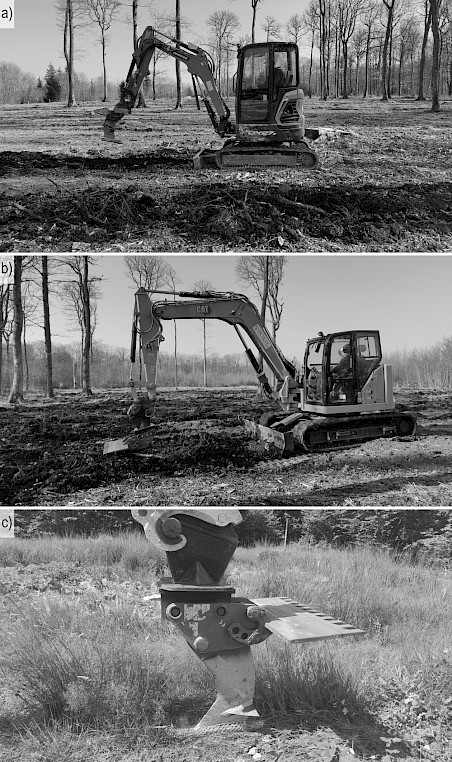
Fig. 1 (a) Small excavator; (b) Large excavator operating during the wet period; and (c) Close view of the tool mounted on the large excavator
The two sites were selected in spring 2021. At each site, we delineated four 2000 m2 plots that were randomly assigned to a MSP treatment x period combination, and two 1300 m2 plots that were left without MSP (unprepared control). In total, ten plots were established: 2 Site x (2 MSP x 2 Period + 1 Control). On October 27, 2021, all plots were entirely shredded to sever the vegetation (herbaceous and small-diameter woody species).
Two operators were hired for the study, one at each site. At each site, the same operator drove the two excavators during the two periods. Instructions were given to the operators to prepare the soil along the future planting lines, spaced 2.5 m apart, to remove all dead and living plant parts on a 1.40 m wide strip, to subsoil the soil down to 40 to 50 cm, and to create a 10 to 20 cm high mound along the planting line.
2.3 Measurements and Data
Soil structure was evaluated using the »cultivation profile method«, a profile wall method described in Roger-Estrade et al. (2004) and Peigné et al. (2013), and adapted to forest soils by Collet et al. (2020) who fully describe the method. In each plot, three spots were selected. Between August 29 and September 9, 2022, a 2 m wide x 1 m deep pit was opened perpendicular to the planting line in each spot and the soil profile in each pit was described. The principle of the method is to examine soil structure and to describe the vertical and horizontal variability that may be caused by tillage, traffic, weathering or soil biota, and to estimate the soil quality for plant root development (Boizard et al. 2017). In each profile, we delimited morphological units with a homogenous morphology and recorded their coordinates. Criteria used to describe soil morphology at the unit scale included soil structure, the presence of cavities, soil color, hydromorphy (traces of oxidation and reduction), organic matter, traces of animal activity and plant roots. We then described the clod spatial organization and intraclod porosity within each unit, and we estimated the quality of each unit using a 6-class scale ranging from »very unfavorable« to »very favorable« to plant root growth.
When performing MSP, the excavators moved backwards and each area of ground was prepared after the machine has passed over it. Consequently, it was not possible to estimate any potential impact of the machine on the soil surface, such as ruts or topsoil displacements. However, we looked at the potential impacts of the machine on deeper soil horizons were considered when describing the profiles, and close attention was paid to traces of compaction beneath the machine pathway.
For each profile, the voids and all traces of smearing or puddling created by the tool teeth were recorded. A two-dimensional map was drawn for each one that synthesized the information collected in the field (Fig. 2), and the map was used to compute various indices of soil structure quality. The height of the mound and the maximum depth reached by the tool were recorded. The latter could only be estimated with a low accuracy.
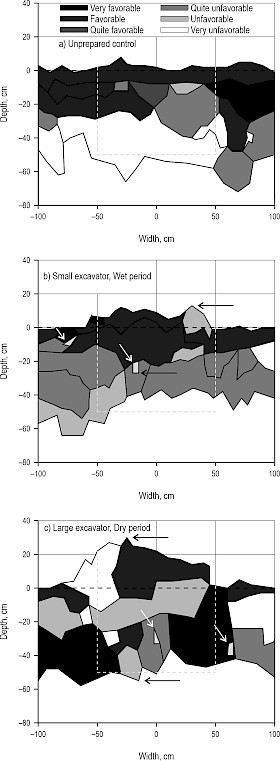
Fig. 2 Example of three cultivation profiles performed at Site 2 (a) in an unprepared Control; (b) in treatment SW (preparation with a Small excavator during the Wet period); and (c) in treatment LD (preparation with a Large excavator during the Dry period). The soil zones of different qualities are represented in different colors. The vertical axis represents soil depth, with zero equal to the natural soil surface, and the horizontal axis is centered on the planting row. The dotted black line represents the level of the natural soil surface. The dotted light gray lines delineate the 100 cm wide x 50 cm deep volume zone centered on the future planting line, which was used to compute soil structure indicators. The black arrows in (b) and (c) indicate the top of the mound created by the tool and the maximum depth reached by the tool. The white arrows in (b) and (c) indicate voids created by the tool
The analysis was then restricted to a focus zone that corresponded to the area where the MSP was applied and to the soil volume that may be prospected by the seedling roots during the first year after planting. In each vertical map, we delineated a 100 cm wide x 50 cm deep zone centered on the future planting line. Within the focus zone, the units of the three classes – »very favorable«, »favorable« and »quite favorable« – were pooled into a single »globally favorable« class, and the units of the five classes – »quite unfavorable«, »unfavorable«, »very unfavorable«, »cavity« and »coarse element« – were pooled into a single »globally unfavorable« class. Then the surface area of each of the two classes was estimated. The upper boundary of the focus area, which corresponded to the soil surface, was not even and, consequently, the total surface area (i.e., the sum of the surface area of the »globally favorable« and the »globally unfavorable« classes in the focus area) varied among the soil profiles (see Results section).
2.4 Statistical Analyses
The impacts of MSP and Period on soil structure were analyzed using ANOVAs. Three types of models were used, depending on the response variable. All models included 30 observations.
The surface area of the globally favorable class (SGloF), the surface area of the globally unfavorable class (SGloU) and the total surface area (STot) were modeled using ANOVAs with two factors, Site [2 levels: Site1; Site2] and Treatment [5 levels: SW (Small excavator, Wet period); LW (Large excavator, Wet period); SD (Small excavator, Dry period); LD (Large excavator, Dry period); C (unprepared Control). Post-hoc tests were performed using linear combinations that tested the effect of MSP (C vs. SW+LW+SD+LD), the effects of the excavator size (SW+SD vs. LW+LW) and the effect of the period (SW+LW vs. SD+LD). The three post-hoc tests were run simultaneously and a Sidak correction was applied to adjust for simultaneous inference.
Mound height (HMound) and maximum depth reached by the tool (DMax) were not defined for the unprepared Control. An ANOVA model with three factors, Site [2 levels: Site1; Site2], Size [2 levels: Small; Large] and Period [2 levels: Wet; Dry], was used to analyze the effects of site, excavator size and period. No interaction was included due to the small number of observations.
To model the number of voids left by the tool teeth (NVoid) in the prepared plots, we used a generalized linear model with three factors, Site [2 levels: Site1; Site2], Size [2 levels: Small; Large] and Period [2 levels: Wet; Dry], with a Poisson error distribution and a log link function. No interaction was included due to the small number of observations.
All data treatments and statistical analyses were performed using the R environment (Lenth 2023; R Core Team 2023).
3. Results
The height of the mound created by the preparation (HMound) averaged 14 cm, and no statistically significant effect of Site, Size or Period was observed (Table 2). The maximum depth reached by the tool did not significantly differ between the two sites or between the two periods (Table 2, Fig. 3). However, equipment size had a significant effect on the maximum depth: it was significantly lower in plots prepared with the small excavator than in plots prepared with the large excavator (DMax = 40 and 53 cm in S and L, respectively).
Table 2 Three-factor-ANOVA models analyzing the impacts of Site (2 levels: S1, S2), Size (2 levels: S, L) and Period (W, D) on two responses variables (HMound: mound height; DMax: maximum depth reached by the tool): models statistics (p-value and adjusted R-squared), F test (p-values) for the factor effects. P-values lower than 0.05 are indicated in bold. Number of observations = 30 in all models

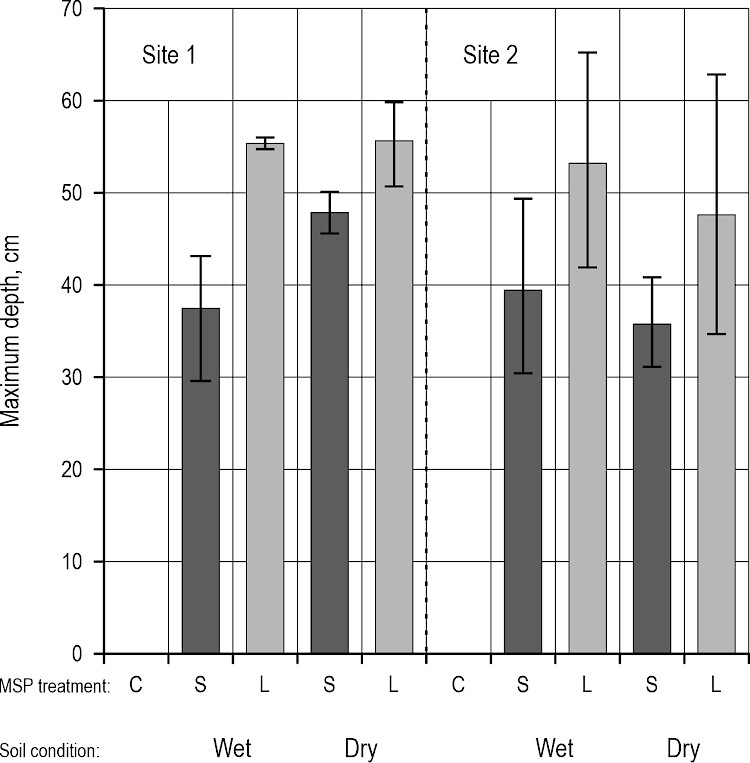
Fig. 3 Maximum depth reached by the tool at the two study sites, according to MSP treatment (unprepared Control, Small excavator, Large excavator) and soil conditions during MSP (Wet period, Dry period): mean value ± standard deviation of the values
The total surface area (STot) described in the focus zone (defined in the vertical soil profile as a 100 cm wide x 50 cm deep area centered on the future planting line) averaged 49.1, 56.4 and 58.5 dm2 in the unprepared control, small excavator preparation, and large excavator preparation, respectively. These differences most probably resulted from the mound created by the tool. However, they were not statistically significant (Table 3). Similarly, no statistically significant differences in STot were observed between the two sites or between the two periods.
Table 3 Two-factor-ANOVA models analyzing the impacts of Site (2 levels: S1, S2) and Treatment (5 levels: C, SW, SD, LW, LD) on three responses variables (STot: total surface area, SGloF: surface area globally favorable to root growth, SGloU: surface area globally unfavorable to root growth): models statistics (p-value and adjusted R-squared), F test (p-values) for the factor effects, F test (p-values) for three linear combinations of Treatment levels (MSP: C vs. SW+LW+SD+LD; Size: SW+SD vs. LW+LD; Period: SW+LW vs. SD+LD). P-values lower than 0.05 are indicated in bold. Number of observations = 30 in all models

The surface area globally favorable to root growth estimated in the focus zone differed among sites (SGloF = 28 and 42 dm2 at Sites 1 and 2, respectively) and among treatments (Table 3, Fig. 4a). The post-hoc tests showed that MSP significantly increased SGloF (SGloF = 23 and 37 dm2, in the unprepared Control and in the prepared plots, respectively) and that SGloF was significantly higher when MSP was performed in the dry period (SGloF = 30 and 45 dm2, in the Wet and Dry periods, respectively). However, no statistically significant effect of excavator size on SGloF was observed.
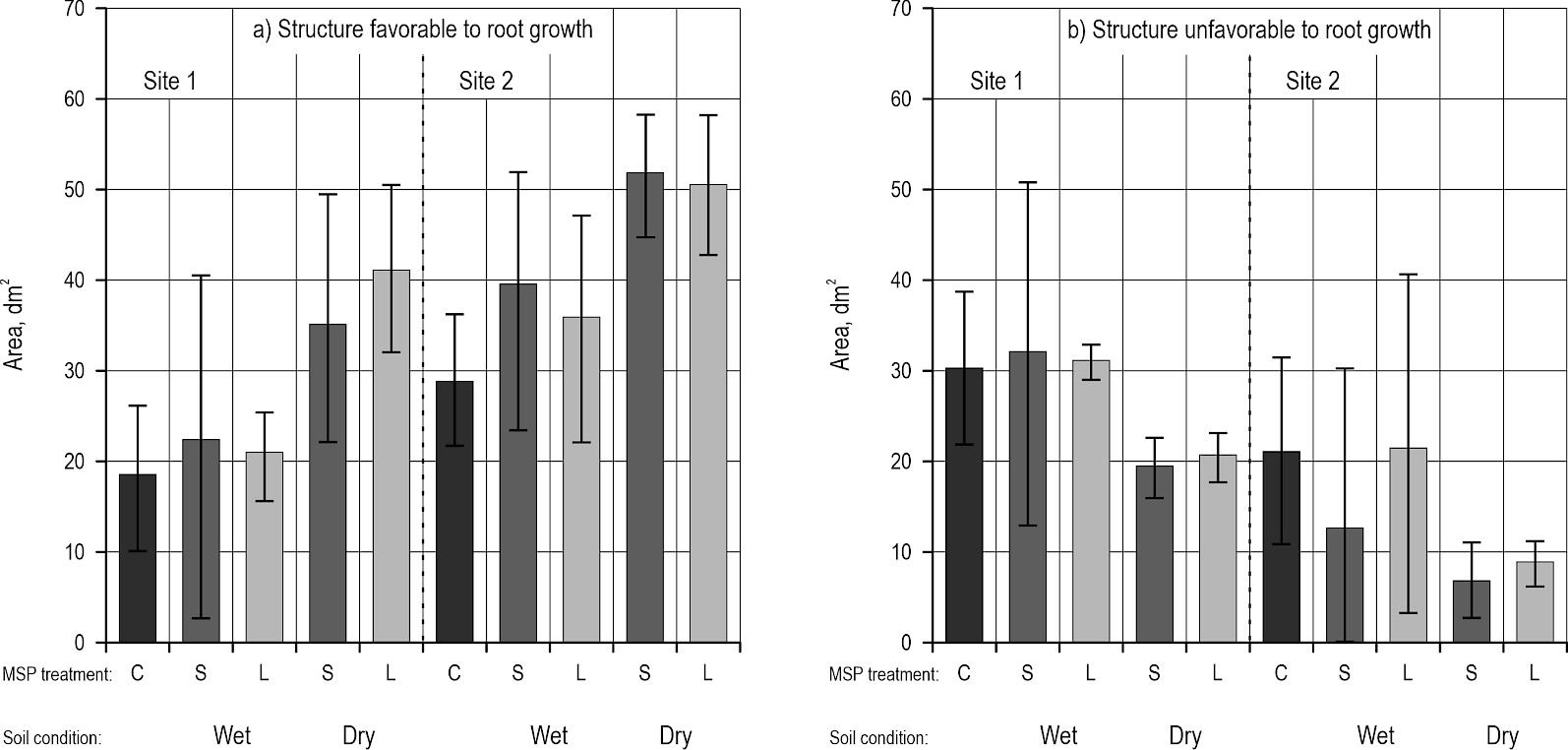
Fig. 4 Soil structure estimated in the focus zone: (a) surface area globally favorable to root growth; and (b) surface area globally unfavorable to root growth at two study sites, according to MSP treatment (unprepared Control, Small excavator, Large excavator) and soil conditions during MSP (Wet period, Dry period): mean value ± standard deviation of the values. The focus zone is defined in each vertical profile as a 100 cm wide x 50 cm deep zone centered on future planting line
In order to examine the relationship between water table depth (DepthWT) and SGloF across sites and periods, the data from the two excavator sizes were pooled and the values of SGloF and DepthWT were compared in the four Site x Period combinations. The two variables were ranked in the same order: DepthWT = 24, 58, 67 and 75 cm and SGloF = 21, 38, 39 and 52 dm2, in combinations Wet-Site1, Wet-Site2, Dry-Site1 and Dry-Site2, respectively.
The surface area globally unfavorable to root growth estimated in the focus zone differed between the two sites (SGloU = 27 and 15 dm2 at Sites 1 and 2, respectively), but no statistically significant effect of Treatment was observed (Table 3, Fig. 4b). Therefore, we considered that MSP, Size and Period did not influence SGloU, although mean value slightly differed between the unprepared control and the prepared plots (SGloU = 26 and 20 dm2, in the unprepared Control and in the prepared plots, respectively).
When describing the cultivation profiles, we did not observe any traces of additional compaction beneath the MSP machine pathway, or any traces of smearing or puddling created by the teeth of the tools in any of the profiles. The number of voids left by the tool teeth ranged between 0 and 5, and averaged 2.2 per profile. No statistically significant effect of the three factors was observed in the glm model (p-value = 0.78, 0.17 and 0.41 for Site, Size and Period, respectively).
4. Discussion
4.1 Effects of Excavator Size, Soil Moisture Content and Site on MSP Outcomes
The dimensions of the excavators employed for MSP in France vary from 2.6 to 21 t, with the most frequently utilized excavators weighing approximately 8 t. The two excavators used in our study fell within this range. In our study, the large excavator prepared the soil to a greater depth owing to the fact that it was equipped with a larger tool and had a greater engine capacity. However, it did not affect any other soil parameters that were described in the cultivation profiles. First, it did not increase the volume of soil favorable to root growth. The discrepancy between this absence of effect and the increase of maximum depth may be attributable to the consideration that the volume of soil favorable to root growth is influenced not solely by the depth reached by the tools, but also by dimensional characteristics such as the height of the mound created by the tool, in addition to structural features such as soil fracturation or soil deterioration induced by the tool. However, these issues were not within the scope of our study. Second, the large excavator did not induce greater degrees of soil degradation that could be observed in the profiles, when compared to the small excavator, even during the wet period.
The two periods investigated corresponded to two distinct periods in which MSP is carried out in practical forestry in France: during the winter or early spring when soils are wet, and during the summer or autumn when the soils tend to be drier. MSP performed during the dry period produced a higher volume of soil favorable to root growth, i.e., soil with friable structure. On the contrary, MSP performed in the wet period produced a lower volume of soil favorable to root growth, indicating that the water content of the soil was above the optimum water content for MPS (Dexter and Bird 2001) used to characterize soil workability.
The two study sites were characterized by a high water table level throughout the winter and spring seasons, and displayed a soil texture that was rich in loam. Consequently, our focus at these sites was primarily on the upper tillage limit (i.e., the »wet« limit) of soil workability. Indeed, MSP produced a more friable soil structure during the dry period compared to the wet period, as well as at the dryer site compared to the wetter site, which indicated that part of the year, an excess of soil water content reduced soil workability. In the soil profiles, no visible sign of additional compaction, smearing or puddling was observed, unambiguously suggesting that the trafficability threshold or the workability threshold during MSP had been exceeded. Nevertheless, the effects of forest machinery on soil structure may not always be readily observable through visual examination alone (Horn et al. 2007) and it may be more appropriate to consider multiple indicators at various levels of observation (such as macro- and micro-porosity, aggregate stability) to determine if soil is compacted or degraded. For this purpose, a quantitative evaluation of soil compaction, such as measures of bulk density, resistance to penetration or infiltration capacity, could provide valuable data for further insight (Or et al. 2021). Many authors (Guimarães et al. 2013, Mueller et al. 2013) have stressed the importance of combining visual soil estimation methods with conventional soil physical methods commonly used to estimate the impact of tillage on soil physical quality (Blanco-Canqui and Ruis 2018, Tian et al. 2022). Such approaches would address the prevailing uncertainties regarding the validity of the results of visual evaluations of soil structure, as well as the consistency of these evaluations across soils with varying textures (Guimarães et al. 2017). Furthermore, it would provide more holistic estimation of soil quality changes following the implementation of MSP.
Trafficability depends on soil properties, soil water content and the specific characteristics of the machine being used. These characteristics include the weight of the machine, the type of soil-contacting device (i.e., wheel or track) and the speed at which the machine is being operated (Cambi et al. 2015, Nazari et al. 2021). In our study, although PMS was conducted on soils that were susceptible to compaction, the use of lightweight (<10 t) tracked machinery that operated at a reduced velocity (<0.60 km h-1) most likely led to diminished compaction. Likewise, workability depends on soil properties, soil water content, and the characteristics of the tool being used (Edwards et al. 2016), such as its design and size, and the power transmitted by the prime mover to the tool (Fielke 1999, Servadio and Bergonzoli 2013). The tool used in our study was designed (taking the geometry of the main tooth and the inclusion of lateral wings into account) to increase the efficiency of soil loosening while simultaneously minimizing the undesirable effects of smearing and puddling. It is expected that the tool induces less deformation in the soil compared to traditional MSP tools such as discs, moldboards, or tines that are pulled by a tractor. However, no direct comparison with conventional tools is available, and such a comparison has yet to be made.
The study was conducted in early spring at a time when the soil conditions were very wet, and in early summer when the soils were drier. We did not examine extremely dry soil conditions that are currently observable in some years with dry summers. However, severe summer droughts are expected to occur with greater frequency in the next decades, increasing the probability of performing MSP on very dry soils. Our results should not be extrapolated to such soil moisture conditions. Evaluating the effects of MSP in these conditions would make it necessary to reproduce our experiment on very dry soils.
The soil characteristics of the two sites exhibited significant variations across several parameters: stoniness, water content, and previous compaction resulting from logging operations. As shown by the observations made in the control plots without MSP, soils conditions in Site 1 (characterized by a lower stone content, elevated water content, and higher compaction) were less favorable to root growth. MSP enhanced soil conditions in both sites, to a similar extent, thus, Site 2 remained comparatively more favorable to root growth, following MSP. The effects of the various soil parameters were not within the scope of our study, so further inquiry into this subject would be highly beneficial.
4.2 Methodological Approach
The study sites exhibited a notable level of spatial heterogeneity at a small scale with regard to the soil, primarily attributed to either logging-related disturbances at Site 1 or the presence of stones at Site 2. These factors induced a difficulty in accurately characterizing the soil structure and amplified the within-treatment variability in most of the soil parameters that were assessed. In addition, the number of observations per treatment was limited because we used a profile wall method, a very labor-intensive approach, to describe soil structure. Despite the heterogeneity of the sites and the limited number of replicates, we were able to detect statistically significant variations between the two machines, the two periods and the two sites, for various response variables. However, it is worth noting that only a limited number of variables displayed a response to the various factors being examined. In order to increase the statistical power of the tests and, consequently, facilitate the identification of significant differences among response variables, we could either use more homogeneous study sites and/or adopt a more time-efficient methodology (for example, combine spade methods for the description of upper soil horizons and penetrometry for the description of deeper horizons).
Study sites were chosen to be representative of conditions commonly observed in forest plantations in the northern part of France: the sites on soils sensitive to compaction with a significant proportion of coarse elements displayed a high water table level during the winter and showed visible logging-induced damage. Choosing a site without these limitations would divert us from the conditions prevailing in the forestry practice. However, it would provide us with the opportunity to more effectively examine the influence of machine attributes and soil conditions on the outcome of MSP. First, it would reduce the variability in all soil parameters that were assessed. Second, it would enable the quantitative assessment of soil properties such as soil strength, bulk density, water content and organic matter content. These parameters, which determine soil response to MSP, could not be assessed at our sites, in particular because of the soil stoniness and the ruts and the uneven soil surface left by the logging operations prior to the establishment of the experiment. The assessment of these parameters is considerably simpler and faster in comparison to the visual estimation of soil structure through the utilization of a profile wall method. As a result, it could be used to consider the spatial variability in soil properties within the stand and, in this respect, would be a complement to the detailed information provided by the profile wall description. Finally, the evaluation of these parameters could serve as a first step towards a modeling approach of the impacts of MSP on soil structure and the estimation of a number of workable days (Obour et al. 2019).
4.3 Recommendations for Management
MSP aims at enhancing plantation success while preserving the overall integrity of the forest ecosystem. In our study, we examined excavators equipped with MSP tools that are used for scalping, subsoiling and mounding. Previous research has demonstrated that this equipment facilitates seedling establishment and early growth (Dumas et al. 2021), mainly due to its ability to control neighboring vegetation. We showed that these MSP methods enhanced the soil structural quality by increasing the volume of soil globally favorable to root growth. Even under wet soil conditions (specifically, at Site 1 during the wet period), there were no indications of soil degradation when compared to the control. The visual soil estimation in the profile wall description suggests that the methods may be used for both high and intermediate levels of soil moisture. However, our study was conducted in two forest stands with soils that had been previously heavily trafficked and were already compacted at the time of the experiment. Most of the compaction damage has been shown to have occurred during the first machine passages, and a soil that has already undergone compaction may exhibit greater resistance to further compaction compared to an undisturbed soil (Cambi et al. 2015). As the trafficability and workability of soil are greatly influenced by its specific characteristics, our results should not be extrapolated to other soil types, which may be more susceptible to compaction and deformation than the soils examined in our study. In addition, we used lightweight (<10 t) excavators mounted on rubber tracks, operating at low speeds and equipped with MSP tools designed to minimize undesirable impacts on the soil, such as smearing and puddling. It should be noted that tractors with higher velocities, heavier machines, machines with wheels or with metal tracks, and machines equipped with other MSP tools may have more noticeable impacts on the soil.
Although the performance of MSP in wet conditions did not have visible negative impacts on the soil, we observed that MSP yielded better results when conducted during the dry period of the experiment. These observations confirm previous findings from field crop studies that have consistently reported reduced soil workability at high soil water content. Therefore, it is recommended that forest operators carefully consider the timing of MSP operations.
5. Conclusion
A profile wall method was used to describe the impacts of MSP on soil structural properties, and to examine the degree to which machine size and soil moisture level influence soil trafficability and workability for MSP activities. In our study sites, MSP performed in dry soil conditions led to a more friable soil structure, which was considered as more favorable to root growth, compared to MSP performed in wet soil conditions. To our knowledge, our study is the first to demonstrate the significance of soil moisture in determining the quality of MSP outcomes in a forestry context.
We also observed that, compared to the small excavator, the large excavator prepared the soil to a greater depth owing to the fact that it was equipped with a larger tool and had a greater engine capacity. However, it did not affect any other soil parameters that could be observed in the cultivation profiles, and did not cause any further visible degradation to the soil, even during the wet period.
Future research should focus on investigating the combined effects of soil types, soil moisture conditions and machine characteristics to develop decision support tools that can assess soil trafficability and workability, and determine the optimal time window for conducting MSP. To run such studies, profile wall methods could be complemented by quantitative evaluation of soil compaction, such as measures of bulk density, resistance to penetration or infiltration capacity.
Acknowledgements
The authors heartily thank Lindsay Godard, Violette Gautier, Fanny Journaux and Jules Defranoux (INRAE) for their valuable help during field measurements. The work was supported by the French Ministry in charge of forests (annual grant: »Soutien au Pôle Renfor«), the Grand-Est region and FEADER fund through the EIP-AGRI network (»PIF« grant). We also thank two anonymous reviewers for their very detailed and constructive comments.
Authors' contributions
All of the authors contributed to the conception and design of the study, to material preparation and data collection. Analyses were performed by CC. The first draft of the manuscript was written by CC, and all of the authors commented on previous versions of the manuscript. All of the authors read and approved the final manuscript.
6. References
Blanco-Canqui, H., Ruis, S.J., 2018: No-tillage and soil physical environment. Geoderma 326: 164–200. https://doi.org/10.1016/j.geoderma.2018.03.011
Boizard, H., Peigné, J., Sasal, M.C., Guimarães, M. de F.,Piron, D., Tomis, V., Vian, J-F., Cadoux, S., Ralisch, R., Filho, J.T., Heddadj, D., De Battista, J., Duparque, A., Franchini, J.C., Roger-Estrade, J., 2017: Developments in the »profil cultural« method for an improved assessment of soil structure under no-till. Soil and Tillage Research 173: 92–103. https://doi.org/10.1016/j.still.2016.07.007
Cambi, M., Certini, G., Neri, F., Marchi, E., 2015: The impact of heavy traffic on forest soils: A review. Forest Ecology and Management 338: 124–138. https://doi.org/10.1016/j.foreco.2014.11.022
Collet, C., Vast, F., Richter, C., Koller, R., 2020: Cultivation profile: a visual evaluation method of soil structure adapted to the analysis of the impacts of mechanical site preparation in forest plantations. Eur J Forest Res. 140(1): 1–12. https://doi.org/10.1007/s10342-020-01315-2
Dexter, A.R., Bird, N.R.A., 2001: Methods for predicting the optimum and the range of soil water contents for tillage based on the water retention curve. Soil and Tillage Research 57(4): 203–212. https://doi.org/10.1016/S0167-1987(00)00154-9
Dumas, N., Dassot, M., Pitaud, J., Piat, J., Arnaudet, L., Richter, C., Collet, C., 2021: Four-year-performance of oak and pine seedlings following mechanical site preparation with lightweight excavators. Silva Fenn 55(2): article id 10409. https://doi.org/10.14214/sf.10409
Edwards, G., White, D.R., Munkholm, L.J., Sorensen, C.G., Lamande, M., 2016: Modelling the readiness of soil for different methods of tillage. Soil and Tillage Research 155: 339–350. https://doi.org/10.1016/j.still.2015.08.013
Fielke, J.M., 1999: Finite Element Modelling of the Interaction of the Cutting Edge of Tillage Implements with Soil. Journal of Agricultural Engineering Research 74(1): 91–101. https://doi.org/10.1006/jaer.1999.0440
Guimarães, R.M.L., Ball, B.C., Tormena, C.A., Giarola, N., Pieres da Salva, A., 2013: Relating visual evaluation of soil structure to other physical properties in soils of contrasting texture and management. Soil and Tillage Research 127(24): 92–99. https://doi.org/10.1016/j.still.2012.01.020
Guimarães, R.M.L., Lamandé, M., Munkholm, L.J., Ball, B.C., Keller, T., 2017: Opportunities and future directions for visual soil evaluation methods in soil structure research. Soil and Tillage Research 173: 104–113. https://doi.org/10.1016/j.still.2017.01.016
Hoffmann, S., Schönauer, M., Heppelmann, J., Asikainen, A., Cacot, E., Eberhard, B., Hasenauer, H., Ivanovs, J., Jaeger, D., Lazdinš, A., Mohatashami, S., Moskalik, T., Nordfjell, T., Sterenczak, K., Talbot, B., Uusitalo, J., Vuillermoz, M., Astrup, R., 2022: Trafficability Prediction Using Depth-to-Water Maps: the Status of Application in Northern and Central European Forestry. Curr Forestry Rep 8(3): 55–71. https://doi.org/10.1007/s40725-021-00153-8
Horn, R., Vossbrink, J., Peth, S., Becker, S., 2007: Impact of modern forest vehicles on soil physical properties. Forest Ecology and Management 248(1–2): 56–63. https://doi.org/10.1016/j.foreco.2007.02.037
Labelle, E.R., Hansson, L., Högbom, L., Jourgholami, M., Laschi, A., 2022: Strategies to Mitigate the Effects of Soil Physical Disturbances Caused by Forest Machinery: a Comprehensive Review. Curr Forestry Rep 8(11): 20–37. https://doi.org/10.1007/s40725-021-00155-6
Latterini, F., Venanzi, R., Papa, I., Đuka, A., 2024: A Meta-Analysis to Evaluate the Reliability of Depth-to-Water Maps in Predicting Areas Particularly Sensitive to Machinery-Induced Soil Disturbance. Croatian journal of forest engineering 45(2): 433–444. https://doi.org/10.5552/crojfe.2024.2559
Lenth, R., 2023: emmeans: Estimated Marginal Means, aka Least-Squares Means. R package version 1.8.9. https://CRAN.R-project.org/package=emmeans
Löf, M., Dey, D., Navarro, R.M., Jacobs, D.F., 2012: Mechanical site preparation for forest restoration. New Forests 43: 825–848. https://doi.org/10.1007/s11056-012-9332-x
Mariotti, B., Hoshika, Y., Cambi, M., Marra, E., Feng, Z., Paoletti, E., Marchi, E., 2020: Vehicle-induced compaction of forest soil affects plant morphological and physiological attributes: A meta-analysis. Forest Ecology and Management 462: 118004. https://doi.org/10.1016/j.foreco.2020.118004
McEwan, A., Steenkamp, J., 2015: Silviculture modernization in the South African forestry industry. In: Atti del Secondo Congresso Internazionale di Selvicoltura. Proceedings of the Second International Congress of Silviculture, Accademia Italiana di Scienze Forestali, 822–826 p.
Mueller, L., Shepherd, G., Schindler, U., Ball, B.C., Juhl Munkholm, L., Hennings, V., Smolentseva, E.N., Rukhovic, O., Lukin, S., Hu, C., 2013: Evaluation of soil structure in the framework of an overall soil quality rating. Soil and Tillage Research 127(2): 74–84. https://doi.org/10.1016/j.still.2012.03.002
Müller, L., Lipiec, J., Kornecki, T.S., Gebhardt, S., 2011: Trafficability and workability of soils. In: Horabik, J., Gliński, J., Lipiec, J. (Eds.), Encyclopedia of Agrophysics. Springer Science + Business Media B.V., Dordrecht, Dordrecht, The Netherlands, 912–922 p.
Nazari, M., Eteghadipour, M., Zarebanadkouki, M., Ghorbani, M., Dippold, M.A., Billyera, N., Zamanian, K., 2021: Impacts of Logging-Associated Compaction on Forest Soils: A Meta-Analysis. Front For Glob Change 4: 780074. https://doi.org/10.3389/ffgc.2021.780074
Obour, P.B., Keller, T., Jensen, J.L., Edwards, G., Lamande, M., Watts, W.C.,Sorensen, C.G., Munkholm, L.J., 2019: Soil water contents for tillage: A comparison of approaches and consequences for the number of workable days. Soil and Tillage Research 195: 104384. https://doi.org/10.1016/j.still.2019.104384
Obour, P.B., Lamandé, M., Edwards, G., Gron Sorensen, C.A., Munkholm, L.J., 2017: Predicting soil workability and fragmentation in tillage: a review. Soil Use and Management 33(2): 288–298. https://doi.org/10.1111/sum.12340
Or, D., Keller, T., Schlesinger, W.H., 2021: Natural and managed soil structure: On the fragile scaffolding for soil functioning. Soil and Tillage Research 208: 104912. https://doi.org/10.1016/j.still.2020.104912
Peigné, J., Vian, J-F., Cannavacciuolo, M., Lefevre, V., Gautronneau, Y., Boizard, H., 2013: Assessment of soil structure in the transition layer between topsoil and subsoil using the profil cultural method. Soil and Tillage Research 127: 13–25. https://doi.org/10.1016/j.still.2012.05.014
R Core Team, 2023: R: A language and environment for statistical computing. R Foundation for Statistical Computing, Vienna, Austria. <https://www.R-project.org/>
Roger-Estrade, J., Richard, G., Caneill, J., Boizard, H., Coquet, Y., Defossez, P., Mnichon, H., 2004: Morphological characterisation of soil structure in tilled fields: from a diagnosis method to the modelling of structural changes over time. Soil and Tillage Research 79(1): 33–49. https://doi.org/10.1016/j.still.2004.03.009
Rounsevell, M.D.A., Jones, R.J.A., 1993: A soil and agroclimatic model for estimating machinery work-days: the basic model and climatic sensitivity. Soil and Tillage Research 26(3): 179–191. https://doi.org/10.1016/0167-1987(93)90043-O
Servadio, P., Bergonzoli, S., 2013: Tractors and machineries for conservative soil tillage in climate change conditions. CABI Digital Library, 6 p.
Sutinen, R., Närhi, P., Herva, H., Piekkari, M., Sutinen, M-L., 2010: Impact of intensive forest management on soil quality and natural regeneration of Norway spruce. Plant Soil 336: 421–431. https://doi.org/10.1007/s11104-010-0492-1
Tian, M., Qin, S., Whalley, R., Zhou, H., Ren, T., Gao, W., 2022: Changes of soil structure under different tillage management assessed by bulk density, penetrometer resistance, water retention curve, least limiting water range and X-ray computed tomography. Soil and Tillage Research 221: 105420. https://doi.org/10.1016/j.still.2022.105420
Turillon, C., Crétin, V., Tomis, V., Duparque, A., 2018: Guide méthodique du test bêche. Structure et action des vers de terre. AgroTransfert, Estrées Mons, France, 16 p.
Varnagirytė-Kabašinskienė, I., Survila, G., Armolaitis, K., 2022: Deep soil ploughing for afforestation: a review of potential impacts on soil and vegetation. Baltic Forestry 27(2): 590. https://doi.org/10.46490/BF590
© 2026 by the authors. Submitted for possible open access publication under the
terms and conditions of the Creative Commons Attribution (CC BY) license (http://creativecommons.org/licenses/by/4.0/).
Authors’ addresses:
Catherine Collet, PhD *
e-mail: catherine.collet@inrae.fr
Chloé Agro, MSc
e-mail: chloe.agro@inrae.fr
Florian Vast
e-mail: florian.vast@inrae.fr
Université de Lorraine
AgroParisTech, INRAE, Silva
F-54000 Nancy
FRANCE
Emila Akroume, PhD
e-mail: emila.akroume@onf.fr
Office national des forêts
Recherche Développement et Innovation
F-39100 Dôle
FRANCE
Malaurie Puyal, Eng
e-mail: malaurie.puyal@onf.fr
Office national des forêts
Recherche Développement et Innovation
F-60200 Compiègne
FRANCE
* Corresponding author
Received: January 30, 2025
Accepted: September 11, 2025
Original scientific paper