
Assessing Forwarder Rolling Resistance During Salvage Logging in Mountain Forest
doi: https://doi.org/10.5552/crojfe.2027.4445
volume: issue, issue:
pp: 16
- Author(s):
-
- Guerra Filippo
- Udali Alberto
- Wagner Thilo
- Marinello Francesco
- Grigolato Stefano
- Article category:
- Original scientific paper
- Keywords:
- rolling resistance coefficient, forwarder, machine–soil interaction, CAN-bus
Abstract
HTML
Logging operations in mountainous environments present unique challenges, particularly in terms of machine-soil interaction and energy demand. The study analyzes the rolling resistance coefficient (µRR) of an eight-wheeled forwarder during uphill salvage logging operations in an alpine forest, using high-frequency machine data collected through a CAN-bus system integrated with GNSS positioning. This approach allows for a detailed assessment of the machine’s rolling resistance under contrasting weather conditions (rainy vs. no rain) and operational settings (winch-assisted vs non-assisted). To reduce variability associated with payload, the analysis focused on uphill, unloaded travel segments. The rolling resistance coefficient was evaluated in relation to terrain features and soil moisture proxies, including slope, cumulative rainfall, and moisture-sensitive areas derived from Depth-To-Water (DTW) maps interpolated for the study area. The results reveal that the µRR is positively correlated with slope and rain, while inversely correlated with DTW. To account for strong temporal autocorrelation and non-linearity, a Generalized Additive Mixed Model (GAMM) was used for inference, while an Extreme Gradient Boosting (XGBoost) model with lag features was implemented for prediction. While raw comparisons showed a positive correlation of µRR with rainy conditions and steeper slopes, the GAMM results (Adjusted R2=0.991) revealed that such effects were largely explained by the mechanical and terrain covariates considered, specifically navigation speed, engine RPM and fuel rate. The XGBoost model achieved excellent predictive accuracy (R2=0.99), identifying recent µRR values (lagged variables) as the dominant predictors, followed by speed and slope. Overall, the findings suggest that while weather and winch use influence the operational context, µRR is primarily governed by short-term temporal dynamics and machine-terrain interactions. These insights provide a robust basis for using machine-sensor data to improve operational planning and reduce energy consumption in sensitive mountainous environments.
Assessing Forwarder Rolling Resistance During Salvage Logging in Mountain Forest
Filippo Guerra, Alberto Udali, Thilo Wagner, Francesco Marinello, Stefano Grigolato
https://doi.org/10.5552/crojfe.2027.4445
Abstract
Logging operations in mountainous environments present unique challenges, particularly in terms of machine-soil interaction and energy demand. The study analyzes the rolling resistance coefficient (µRR) of an eight-wheeled forwarder during uphill salvage logging operations in an alpine forest, using high-frequency machine data collected through a CAN-bus system integrated with GNSS positioning. This approach allows for a detailed assessment of the machine’s rolling resistance under contrasting weather conditions (rainy vs. no rain) and operational settings (winch-assisted vs non-assisted). To reduce variability associated with payload, the analysis focused on uphill, unloaded travel segments. The rolling resistance coefficient was evaluated in relation to terrain features and soil moisture proxies, including slope, cumulative rainfall, and moisture-sensitive areas derived from Depth-To-Water (DTW) maps interpolated for the study area. The results reveal that the µRR is positively correlated with slope and rain, while inversely correlated with DTW. To account for strong temporal autocorrelation and non-linearity, a Generalized Additive Mixed Model (GAMM) was used for inference, while an Extreme Gradient Boosting (XGBoost) model with lag features was implemented for prediction. While raw comparisons showed a positive correlation of µRR with rainy conditions and steeper slopes, the GAMM results (Adjusted R2=0.991) revealed that such effects were largely explained by the mechanical and terrain covariates considered, specifically navigation speed, engine RPM and fuel rate. The XGBoost model achieved excellent predictive accuracy (R2=0.99), identifying recent µRR values (lagged variables) as the dominant predictors, followed by speed and slope. Overall, the findings suggest that while weather and winch use influence the operational context, µRRis primarily governed by short-term temporal dynamics and machine-terrain interactions. These insights provide a robust basis for using machine-sensor data to improve operational planning and reduce energy consumption in sensitive mountainous environments.
Keywords: rolling resistance coefficient, forwarder, machine–soil interaction, CAN-bus
1. Introduction
The implementation of effective forest management requires a considerate balance between economic productivity and environmental preservation, particularly when it comes to the use of heavy machinery in forest operations in sensitive areas (Grünberg et al. 2023).
Considering the ground based extractions, a key challenge is the number of passages (traffic) and related impact, as forest soils are often susceptible to compaction and rutting (Nazari et al. 2021), which can negatively impact tree growth (e.g. Reisinger et al. 1988, Ampoorter et al. 2011, Naghdi et al. 2016, Martin et al. 2024), water infiltration (e.g. Ampoorter et al. 2012, Toivio et al. 2017, Martin et al. 2024), soil physical properties (e.g. McNabb et al. 2001, Labelle and Jaeger 2011) and run-off (Picchio et al. 2021).
One of the most noticeable impacts of machine traffic is the formation of wheel ruts. To prevent excessive damage, many countries (e.g., Germany – Act on the Protection against Harmful Soil Changes and the Remediation of Contaminated Sites in Germany, Federal Soil Protection Act) regulate acceptable soil disturbance through legislation, while international forest certification standards, such as the »Programme for the Endorsement of Forest Certification (PEFC) and Forest Stewardship Council« (FSC) also incorporate these considerations. These impacts are amplified when harvesting operations are performed in already damaged environments, such as after a large disturbance: in this case, salvage logging operations could augment the risks for soil exposure and erosion (Robichaud et al. 2020, Prats et al. 2021), as well as fertility loss (Valipour et al. 2021). For example, the Northeastern Italian Alps have seen recent intensification in machine traffic due to large disturbances (Di Marzio et al. 2025) and subsequent salvage logging operations conducted with ground-based heavy machinery (Cadei et al. 2020, Udali et al. 2023).
Trafficability maps are key decision support tools for forest operations, providing spatial information on terrain and soil characteristics, and moisture conditions to assess machine mobility. A commonly recognized support method in the planning of harvesting and forwarding operations is provided by predicting low soil bearing capacity due to wet soil conditions (Hoffmann et al. 2022). One of the most adopted methods to assess that is through the use of Depth to Water maps (DTW): these maps provide information regarding the depth and extent of the water table relative to the ground surface, therefore providing information of possible surface overflow (Salmivaara et al. 2020, Schönauer et al. 2021). These tools have seen extensive use in Boreal forests to predict perennial streams, wet or water-saturated areas, and sensitive areas for ground-based trafficking (Ågren et al. 2014, 2015). More recently, DTW maps have been documented to predict soil strength and areas prone to higher machinery-induced compaction in Northern and Central European forests (Hoffmann et al. 2022, Guerra et al. 2024b), and also in Mediterranean forests (Latterini et al. 2022). Another key factor influencing machine performance is the rolling resistance, defined as the friction force that a vehicle must overcome to move forward (Suvinen and Saarilahti 2006), which depends on soil properties and machine-soil interactions; it directly affects energy consumption and machine mobility in forest operations (Ala-Ilomäki et al. 2011, Mattila and Tokola 2019). Among soil and terrain properties, machine rolling resistance is mainly influenced by moisture content, slope gradient, and vegetation cover (Ala-Ilomäki et al. 2020, Salmivaara et al. 2024). When machinery, such as forwarders, register higher rolling resistance, this results in increased energy consumption, reduced productivity, and heightened risk of soil compaction (cf. Ampoorter et al. 2012). Moreover, soil deformation and surface roughness further contribute to rolling resistance, especially in off-road conditions typical of forest operations (Kurjenluoma et al. 2009), often highlighted by repeated passages after extensive clear-cutting (Bygdén et al. 2003).
In steep terrain operations, winch-assisted, or tethered logging has been developed to enhance the stability and traction of forest machinery by providing additional support, therefore reducing wheel slippage, and to distribute machine weight more effectively, leading to decreased soil disturbance and rut formation (Breinig et al. 2025). Recent studies have demonstrated that winch-assisted harvesting offers a sustainable option for utilizing highly productive machinery with reduced soil impact in steep terrain, up to 52% in slopes (Allman et al. 2024).
To better understand machine’s behavior and interactions with the surrounding environment, modern machinery equipped with a CAN-Bus systems can be monitored with a CAN-Logger to record key machine parameters in real-time. These systems provide valuable data on factors such as wheel speed, load, and engine performance, which can be used to calculate rolling resistance and optimize operational efficiency. Ala-Ilomäki et al. (2020) reported how forest machines’ rolling resistance derived from CAN-bus data could provide useful information to map site trafficability during machine work, therefore be able to predict machine mobility. Similarly, Salmivaara et al. (2024) showed how harvester data collected at high resolution, with the joint use of DTW maps, can predict the occurrence of extreme rolling resistance values. This information enables the authors to predict site trafficability for better planning timber extraction operations.
Moreover, environmental factors, particularly weather conditions, can significantly affect forest operations. Precipitations, for instance, increase soil moisture, reducing soil bearing capacity and increasing the risk of soil compaction and deformation, which in turn elevates the rolling resistance (Melander et al. 2019). Frozen ground, for example, has been shown to have higher bearing capacity providing less friction at machinery passage (Schönauer et al. 2022, Salmivaara et al. 2024).
When considering harvesting operations affecting largely disturbed forest areas, the combination of environmental and climatic factors can create a challenging environment. Within this context, the aim of this study was to investigate the interactions between machine and soil in a mountain environment, characterized by forest disturbance and moisture-sensitive terrain. Despite the extensive research on rolling resistance in forestry, few studies have explored its dynamics in salvage logging contexts, especially in mountainous regions (cf. Hoffmann et al. 2022). This study builds upon previous research that explored the integration of machine management data with soil, terrain, and climatic variables to estimate machines performance (Guerra et al. 2024b). Additionally, it extends the investigation into the reliability of CAN-Bus data for assessing forwarder rolling resistance under real working conditions (Guerra et al. 2024a).
This study aims to examine the rolling resistance coefficient (µRR) of a forwarder during uphill operations on skid trails in a mountain forest heavily affected by bark beetle outbreak after a windthrow event. Specifically, the study also aims to:
- compare µ RR differences between winch-assisted and non-assisted extractions
- assess the impact on µ RR of varying conditions due to rainfall
- moisture-sensitive terrain
- address the combined terrain and conditions effects under real working conditions.
2. Materials and Methods
2.1 Monitored Site and Conditions
The study took place in the Northeastern Italian Alps (N 46°18'24" – E 11°43'42"), located in the province of Trento, at an altitude of 1650 m a.s.l. within the Paneveggio forest, owned by the Autonomous Province of Trento (Fig. 1). The forests consist of a typical spruce mountain forest, dominated by Norway spruce (Picea abies (L.) H. Karst) and larch (Larix decidua Mill.), with an average growing stock of 425 m3·ha-1. The forest soil is heavily influenced by the presence of Dolomitic, volcanic, and metamorphic rock, depending on the area, providing a rich substrate for different herbaceous species to thrive, and the establishment of multiple ecosystems and habitats. These areas were all impacted by the Vaia storm at the end of October 2018, with consequent salvage logging operations, and by bark beetle outbreak (Ips typographus L.) in 2022.
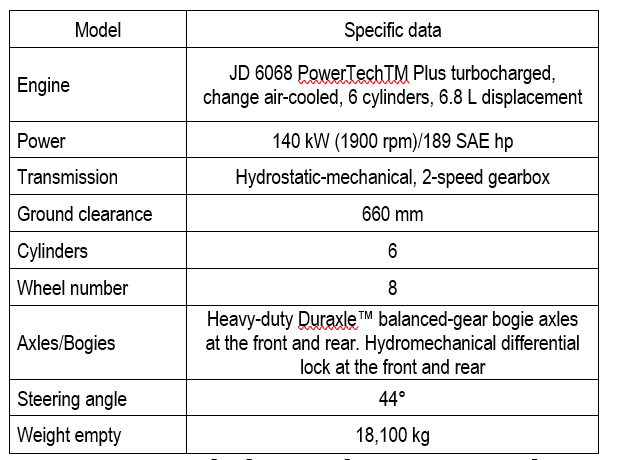
In particular, the selected forest was entirely composed of Norway spruce, with some larch, and the soil was classified as clay loam with an organic horizon between 10–20 cm, based on available regional soil maps and previous site characterization. The study site covered an area of 5 ha with a stand density of 270 trees ha-1; it was subjected to a bark beetle outbreak at the beginning of summer 2023, and therefore the salvage operations were performed in early fall of the same year (from 04/09/2023 to 03/10/2023), using ground-based machinery and Cut-To-Length system. The timber was mechanically felled by a harvester machine and then extracted and transported by a forwarder to the forest road. The forwarder used in this study was a John Deere model 1210E, a medium size category machine with loading capacity of 13 t (Brunberg 2004, Stankić et al. 2012). The machine was equipped with off-road tires and traction tracks on both the front (Olofsforst ECO™ tracks, Nordmaling, Sweden) and rear (Olofsforst Baltic™ tracks, Nordmaling, Sweden) bogies for steep field operations, as well as with a synchronized traction aid cable winch (Fig. 2). This machine configuration was maintained during the logging operations, in all conditions. Further details are available in Table 1.
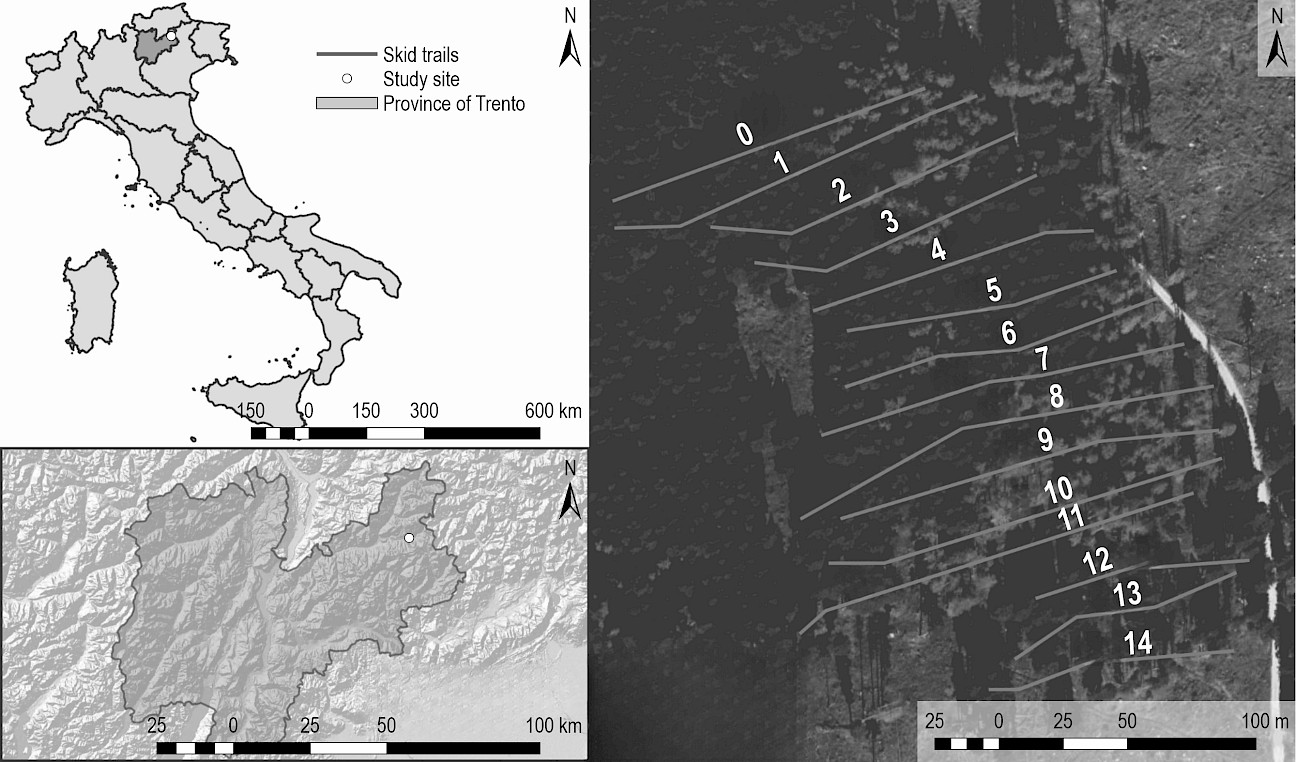
Fig. 1 Distribution of the monitored skid trails in the study site. Skid trails geometry has been simplified for clarity of representation
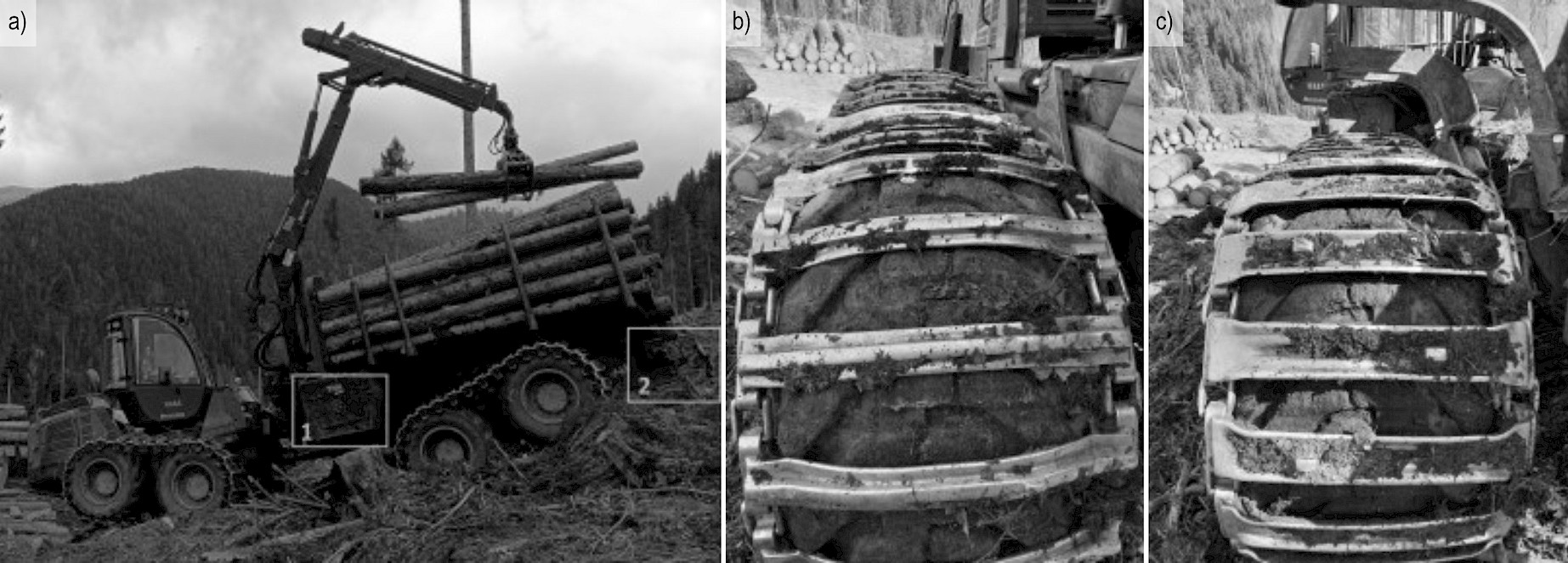
Fig. 2 Configuration of the monitored forwarder: (a) set up for the winch storage (box 1) and anchor tree hook (box 2); (b) front traction wheel tracks and (c) rear wheel tracks
Table 1 Details and technical specifications of the forwarder used in this study
2.2 Data Acquistion and Pre-Processing
The data collection was based on a CANedge2 datalogger (CSS Electronics), interfaced with the vehicle Controller Area Network (CAN) bus and equipped with a Global Navigation Satellite System (GNSS) antenna for machine position tracking. The recorded parameters included date and time, geographic coordinates (longitude and latitude), engine rotational speed (RPM), and ground speed (m s-1), all recorded with a frequency of 1 s. Information on the use of the traction winch was not directly available from the CAN bus and was therefore added based on field observations.
All data preparations and analyses were performed using R in the RStudio environment (RStudio 2025.09.2+418 »Cucumberleaf Sunflower«), with the resulting workflow summarized in Fig. 3. Prior to any operation, the machine data was filtered and summarized every 5 seconds. From the position information, the machine's mobility was interpolated, showing 15 main skid trails via QGIS. Each of the trails was also identified through field observations and assigned an identification number (id). Following the synchronization of each monitored workday with the corresponding skid trail traversed by the forwarder, an initial comprehensive dataset was generated detailing the skid trail characteristics for each work cycle. Following previous results from Guerra et al. (2024a), to properly compute the µRR,only uphill-unloaded forwarder data was considered for each work cycle. This was performed to avoid including more variability in the computation of the µRRdue to variable payloads and assortments. In addition, frequent stops of the forwarder due to the use of the log-loading grapple (downhill) are difficult variables to isolate in the CAN-bus derived data. The information was isolated by automatically selecting a series of GNSS positions starting at roadside (unloading zone) to the farthest point, i.e. the moment when the forwarder starts the loading work phase.
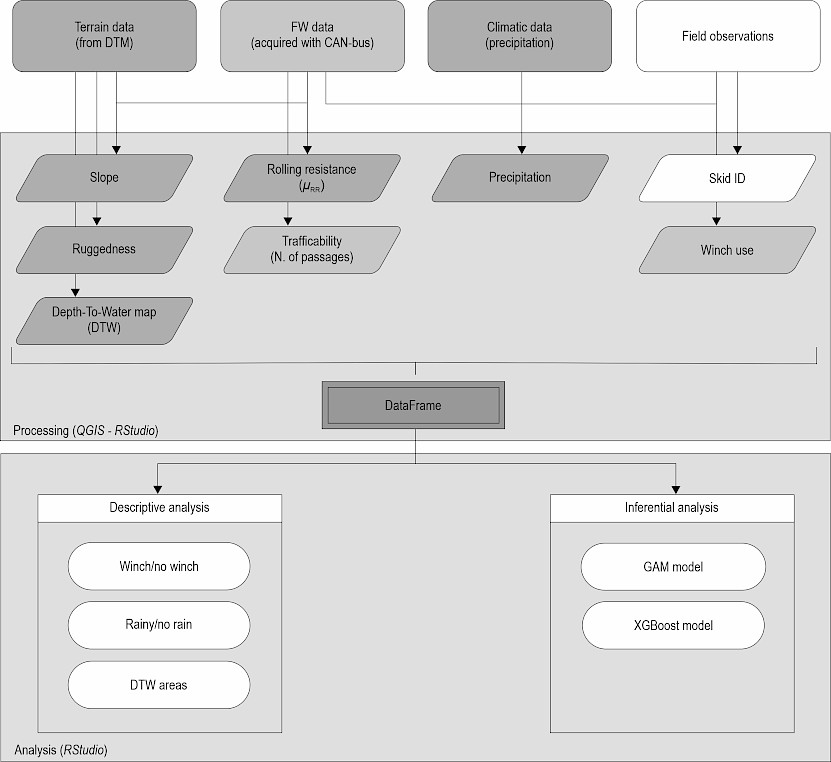
Fig. 3 A summary of the workflow for data collection and dataset implementation
2.3 Calculation of Rolling Resistance Coefficient
The main focus of study was the rolling resistance, defined as the friction force that a vehicle must overcome to move forward (Suvinen and Saarilahti 2006), as reported in previous studies (Ala-Ilomäki et al. 2020, Salmivaara et al. 2024). The rolling resistance force (FRR) is expressed as a function of the normal force (N) and the rolling resistance coefficient (µRR) (Eq. 1).
The rolling resistance force was derived from the equilibrium of forces acting on the vehicle during uphill travel (Eq. 2), where the motive force (Fm) counteracts both rolling resistance and the slope force (Fs).

In this study, the motive force (Fm) was estimated from the expended power acting on the wheels (Pw) and the forwarder ground speed (v), according to Eq. 3. The expended power was computed following the same approach described by Guerra et al. (2024a), which is based on engine rotational speed (RPM) recorded via the CAN bus and assumes a constant drivetrain efficiency.

When the traction winch is engaged, the recorded engine RPM reflects the total engine load required to simultaneously supply both the drivetrain and the winch system. As direct measurements of the power split between drivetrain and winch were not available, Pw represents an aggregated estimate of the engine power contributing to vehicle motion under assisted conditions. On the other hand, the slope force (Fs) was calculated as the component of the vehicle weight (W) acting parallel to the terrain slope (α), while the normal force (N) corresponds to the perpendicular component (Eqs. 4 and 5).

The slope force is subtracted from the motive force when driving uphill, as shown in Eq. 2. Finally, considering the normal force acting on the machine, µRRwas calculated by dividing the rolling resistance force by the normal component of the vehicle weight (Eq. 1).
2.4 Dataset Implementation
Specifically, for this study, the motive force Fm was estimated using CAN-bus GNSS data, which provided the vehicle's speed necessary for converting the expended power into motive force (Eq. 3). The slope angle, and therefore the slope force (Eq. 4) and the normal force (Eq. 5), were determined by extracting the terrain slope under the GNSS positions over the digital terrain model (DTM), available at provincial level. Over the same DTM, the terrain ruggedness was interpolated and added as ancillary information for each position. Climatic data, specifically cumulative rainfall (mm), were obtained from the Province Meteorological Service for the duration of the study, including a one-month period preceding the start of operations, which did not record any particularly significant rainfall but a similar condition to those observed during the investigated period. Consequently, each skid trail was assigned a cumulative rainfall value based on the specific days of operation during which precipitation occurred. The information related to the machine position and µRR was investigated in relation to the DTW (Depth to Water) maps of the area. These maps provide information regarding the depth and extent of the water table relative to the ground surface. To build the DTW map for the study area, the procedure described by Schönauer et al. (2021) was followed.
In addition, machine traffic was quantified by estimating the number of passages over each skid trail segment, starting from the recorded GNSS positions (Cao et al. 2025). To achieve this, starting from the CAN bus-derived information, the density of recorded positions was determined using a Kernel Density Estimation (KDE) applied to the spatial distribution of GNSS positions to delineate the main areas of machine transit. Then, the area was simplified into smaller polygons, and for each of them, midlines were automatically drawn using the »midlines« package (Patterson 2024). Finally, the midlines were brought together and used with positions to assess the number of passages that occurred over each skid segment. This information was then coupled with the main dataset based on the skid id reference. All information were then collected into a data frame that was queried to provide a data summary for each skid trail through an iterative process. At the end of the process, for each skid trail, several summary statistics were calculated.
2.5 Data Frame Analysis
The obtained data frame was mostly unbalanced because of the factors initially considered to influence machine’s rolling resistance, therefore two statistical approaches have been devised. As the data frame includes dense repeated measurements and shows strong temporal dependence, both descriptive, unadjusted group comparisons and adjusted inferential models are presented. The unadjusted tests summarize raw distributional differences, whereas the inferential models account for nonlinear covariate effects, clustering and autocorrelation; a complementary predictive model evaluates variable importance in prediction. In the first case, for the unadjusted group comparisons, the rolling resistance coefficient (µRR) values distribution were first checked for normality using the Kolmogorov-Smirnov test, ideal for large dataset. Since the data did not meet the assumptions for normality, the following statistical analysis was conducted using non-parametric tests.
- »Winch presence and rainfall conditions« . The information was grouped by either the presence/absence of the use of winch and then by the presence or absence of rainfall during the investigated period. In both cases, the differences were tested using a Mann-Whitney U test. Moreover, the general hypothesis tested that, on average, the mean µ RR values would be different in the case of the use and non-use of tethered harvesting and in rainy/no rain conditions.
- »Analysis of traffic over DTW areas«. To investigate the influence of transit in water sensible areas, the machine positions were then coupled with DTW maps. The values were extracted and divided into classes going from 0 (surface overflow of water) to 1 (no water) by intervals of 0.25. The values were checked through Kruskal-Wallis test and Dunn’s test to evaluate the significance between classes.
In the case of inferential models, with the attempt to describe the real working conditions, since µRR observations were summarized at 5-s intervals and exhibited strong temporal autocorrelation and nonlinearity, the model chosen explicitly accounted for assessing serial dependence and non-linear effects. For inferential analysis, a Generalized Additive Mixed (GAM) model with random intercepts for work cycle and transect, an AR(1) residual structure, and a dispersion model to allow heteroscedasticity were selected to inspect smooth nonlinear effects (from the mgcv package). For prediction, a gradient-boosted trees (XGBoost) model featuring lag and rolling summary features was trained; the model also used grouped cross-validation by work cycle and stratification by µRR quantiles. Such a model is particularly effective for regression due to its effectiveness in handling unbalanced datasets, missing values, and scalability problems (Zhang et al. 2022). The model was set up with a 70/30 training/testing split, with the performance assessment via RMSE, MAE, and per-quantile errors. Moreover, the R2 was also computed to show the model’s power to explain the variance in µRR.
3. Results
3.1 Overview of Rolling Resistance Coefficient
The results of rolling resistance coefficient (µRR) measured on 14 skid trails in the salvage logging site are summarized in Table 2. The skid trail identified as skid 0 was entirely worked downhill, therefore it was excluded from the present analysis. The slope of the skid trails ranged between 21.6% and 31.4%, with the corresponding µRR values ranging from 0.09 to 0.23. When timber extraction was conducted with the aid of the winch system, the values recorded ranged between 0.10 and 0.14, similar to the business-as-usual, but averaging a higher mean slope compared to no winch-assisted trails. Fig. 4 shows the relationship between the slope and the µRR per the different skid id, distinguishing the working conditions in which the winch-assisted extraction was performed.
Table 2 Main results of logged skid trails. The table includes the average slope, average rolling resistance coefficient (µRR), indication if it was raining during the operations on the skid, and use of winch
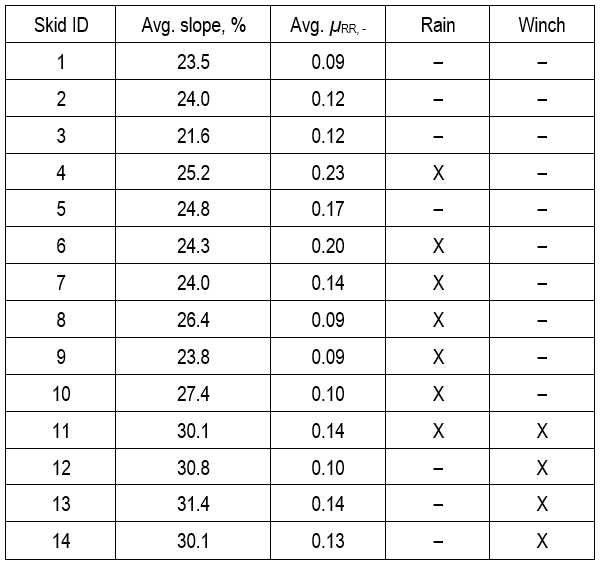
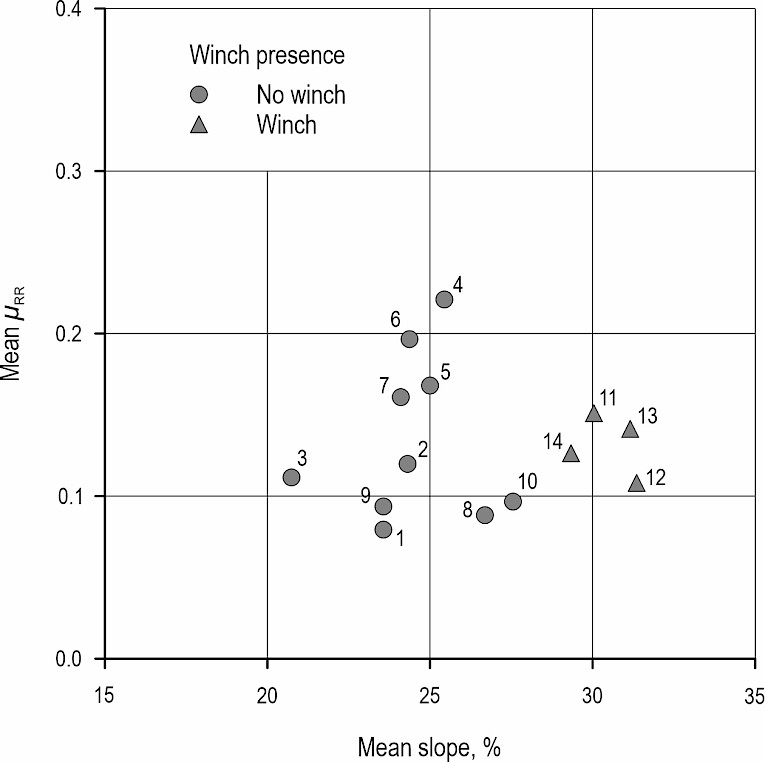
Fig. 4 Plot of mean µRR and mean slope across different skid trails. Information on the use of winch is also reported
3.2 Winch and Rain Conditions
Throughout the observed period, the assisted winch system settings (including the preselected tensile force and synchronization parameters) were kept constant by the operator. This ensured that rolling resistance was not influenced by variations in winch-assisted tension but was instead primarily affected by soil conditions. Descriptively, non-parametric comparison indicated some differences between groups. When it comes to the impacts of the different working conditions, the analysis was split between the use of the winch and the work performed on days that registered precipitation phenomena. The Mann-Whitney U test showed no statistically significant differences between the median values in skids with and without winch assistance (p-value=0.5018). This result suggests that while the winch provides traction assistance, the overall effect on rolling resistance may be limited, likely due to an increase in terrain slope (Fig. 5a). However, winch-assisted skids had significantly steeper slopes, on average 30.5% compared to 24.4% for non-winch skids (p-value=0.0015), indicating that the winch was predominantly used on more challenging terrain. On the other hand, the statistical analysis displayed that rainfall had a significant impact on rolling resistance: skid trails that experienced rainfall exhibited notably higher µRR values, confirming the hypothesis that soil moisture increases rolling resistance (p-value<2.2e-16) (Fig. 5b).
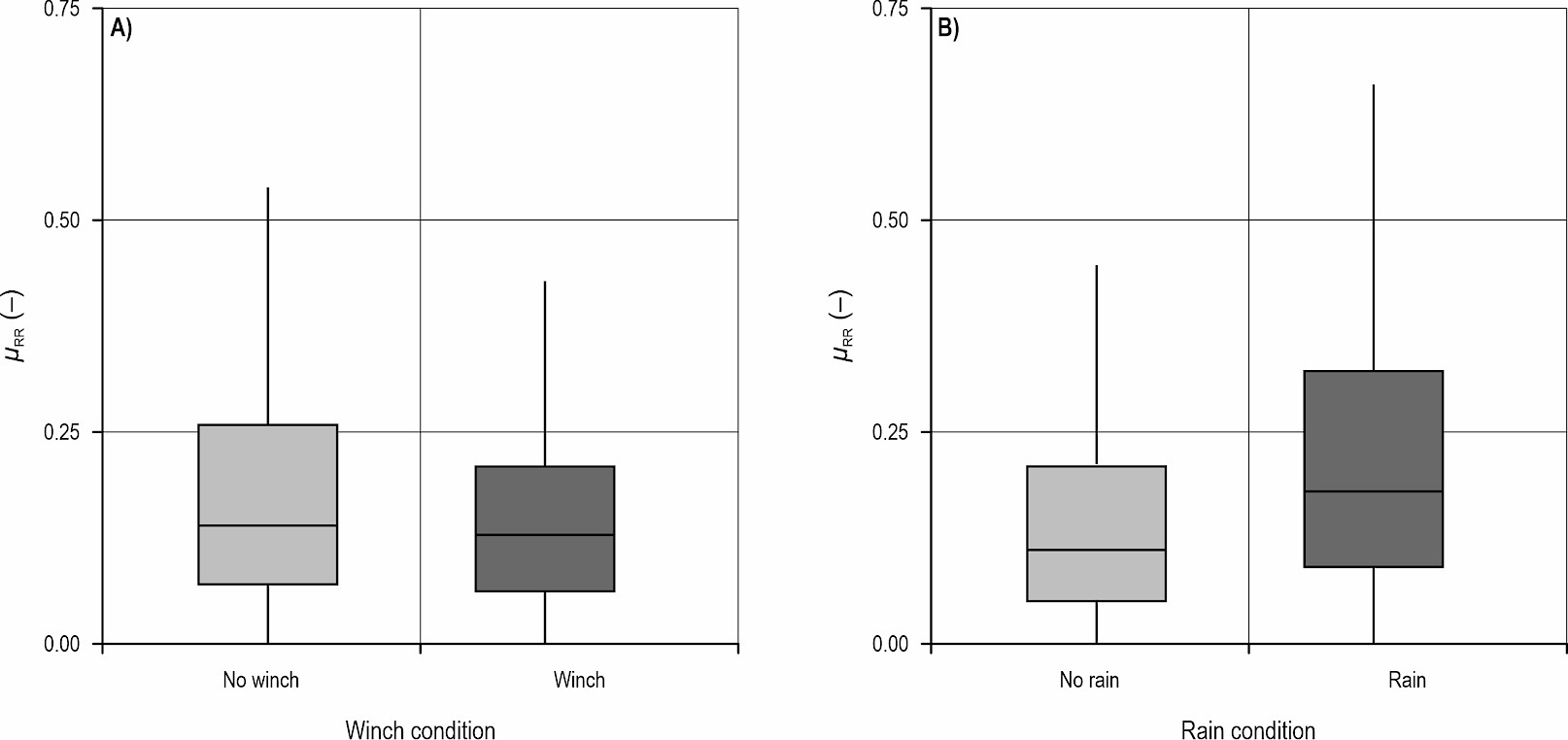
Fig. 5 A representation of the rolling resistance coefficient (µRR) under different conditions. (A) Comparison of values with and without the use of a winch; (B) Comparison of values with or without rain
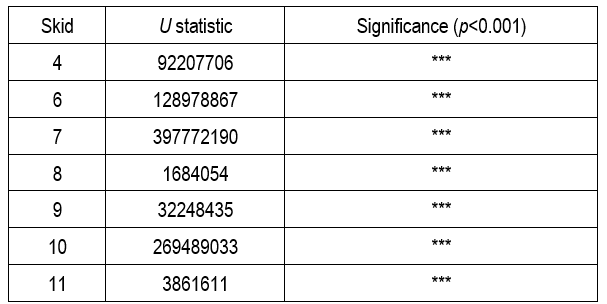
To further analyze the impact of weather conditions (rainy vs. no rain) on the rolling resistance, a detailed analysis was conducted by performing Mann-Whitney U test by selecting the data belonging to the skid trails that were exploited on rainy days as well as data from the same trails but exploited on non-rainy days (Fig. A2); after this, each skid was examined individually. The results (Fig. 6 and Table A1) revealed statistically significant differences in µRR upon the weather conditions examined for all skids (p<0.001). In general, even in the trails where the difference in the mean values is very small, the statistical significance suggests that the effect is detectable and corresponds to differences that might be observed in the field. In all skid trails, with the exception of skid trail 11, the mean µRR value was higher in rainy conditions than in dry conditions.
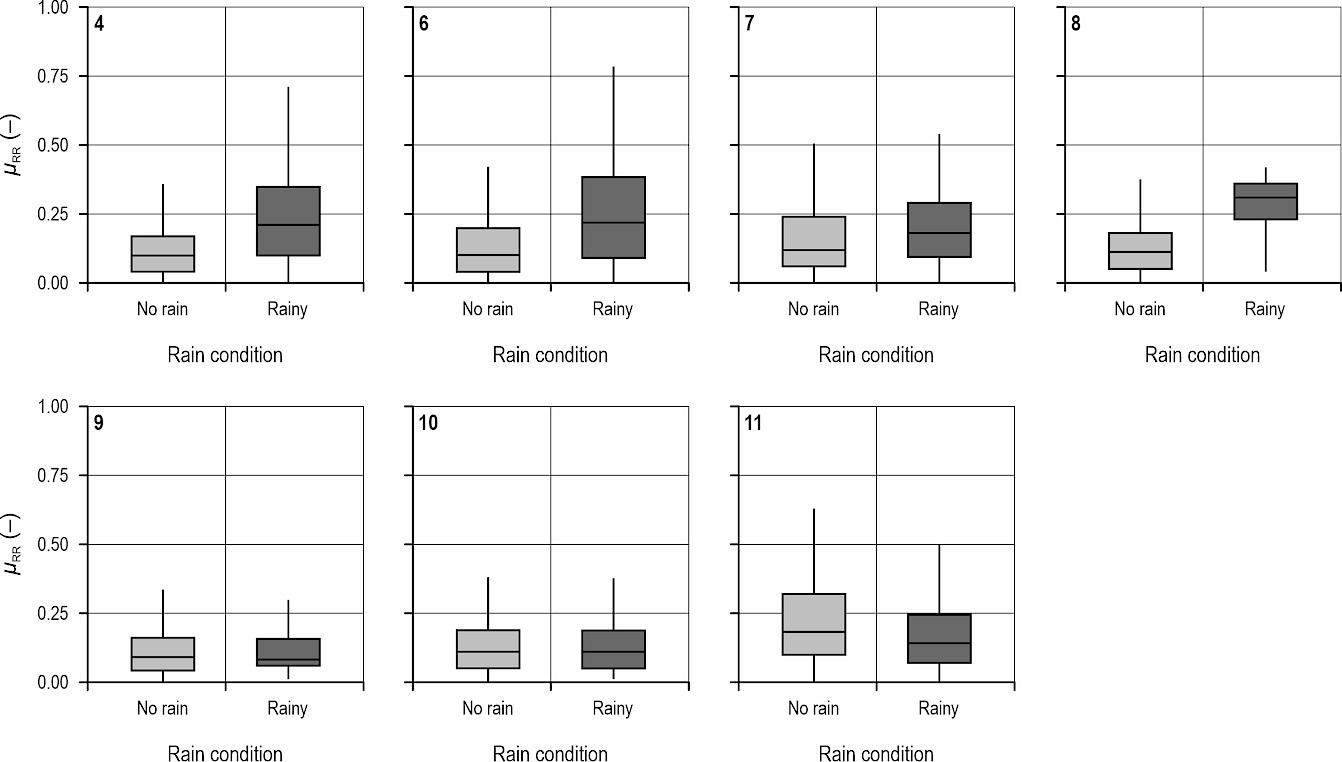
Fig. 6 Boxplot showing the distribution of the rolling resistance coefficient (µRR) for each skid trail under rainy (dark grey) and non-rainy (light grey) conditions. The y-axis for each plot shows the rolling resistance coefficient
3.3 Rolling Resistance Trend over DTW Areas
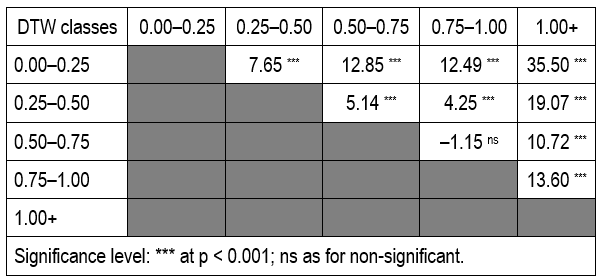
Regarding the rolling resistance values with respect to the DTW areas, the Kruscal-Wallis test provided highly significant differences between classes (p<0.001). Dunn’s test was then used to check for significant differences between the different classes, with results reported in Table 3. In general, the test statistics reflect how far apart the groups are in terms of standard deviations, with larger absolute values of the Z-statistics indicating larger differences between the groups considered. The class with DTW values higher than 1.00 has the largest differences compared to the other classes, with high significance. Additionally, µRR values in the lowest DTW class (0.00–0.25) are significantly different from coefficient values in larger DTW classes, and considerably higher in values (considering the negative difference). Therefore, the rolling resistance decreases with the increase of DTW values (closer to 1.00), with trails in wetter areas displaying higher µRR.
Table 3 Results of Dunn’s test Z-statistic for significant differences of µRR values between DTW classes, with p-value adjusted using Bonferroni method
3.4 Trend in Real Working Conditions
To obtain adjusted, inference-grade estimates that account for repeated observations, autocorrelation and nonlinear effects, a GAM model was fitted with random intercepts for work cycle and transect and AR(1)-style handling of temporal dependence. The model revealed strong nonlinear relationships of µRR with machine (i.e., navigation speed, engine fuel and RPM) and terrain variables (i.e., slope and DTW values); all with smooth terms with high significance levels (p<2e-16). After checking for these effects and for within-cycle dependence, the parametric effects of winch use and instantaneous rainfall resulted small and not statistically significant (winch: estimate =−8.6e-04, p=0.206; rainfall: estimate =−7.7e-05, p=0.126). This indicates that the apparent differences seen in unadjusted tests are largely explained by mechanical and terrain covariates (especially navigation speed and slope) and by temporal dependence in the series. Overall, the model fit was able to undercover how most of the variance could be explained by deterministic relationships, e.g., RPM, navigation speed, engine fuel (adjusted R2 of 0.991).
The findings from the XGBoost model achieved excellent predictive accuracy with limited differences between predicted and observed values (RMSE=0.0051; R²=0.99) and identified the strongest predictors as the recent µRR values (lag1≈69% importance, lag2≈24%) followed by navigation speed, slope and RPM. Rainfall and winch use had negligible importance in prediction. Together, these results showed that µRR was predominantly governed by its recent temporal dynamics (lag variables) and by machine-terrain conditions; weather conditions and winch presence have only a minor direct role once the primary drivers are accounted for (Fig. 7). Nevertheless, the DTW analysis and the within-skid comparisons indicate that wetter areas and rainy days are associated with higher µRR in raw comparisons, consistent with physical expectations that soil moisture increases rolling resistance.
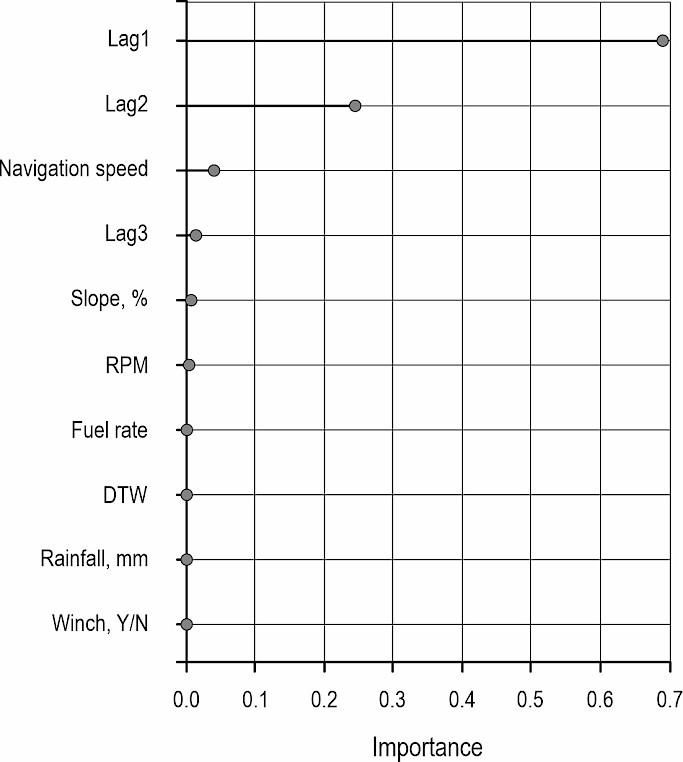
Fig. 7 Variable importance for the XGBoost model
4. Discussion
The findings of this study highlight several key factors influencing the rolling resistance coefficient (µRR) during salvage logging in mountainous forest environments. The most notable result is the clear impact of both terrain features and weather conditions, confirming the role of µRR in depicting soil-machine interaction (Bygdén et al. 2003, Salmivaara et al. 2024). However, from the results shown, it appears clear that this relationship is not easily deliverable and understandable. From the descriptive analysis, skid trails with steeper slopes consistently showed higher coefficient values, underscoring the role of gravitational forces in increasing rolling resistance. This result aligns with the established understanding that steeper terrain presents greater resistance to machinery movement due to both increased ground deformation and the energy required to overcome elevation gradients (Kurjenluoma et al. 2009, Hittenbeck 2013). In this case, the use of the winch on steeper slopes (greater than 28–30%) resulted in low rolling resistance values and in potentially reducing the impact on the soil. Similarly, Breinig et al. (2025) registered comparable soil damage on winch-assisted and non-assisted timber extraction using a heavier machine, but on a 3.5% slope, whereas Allman et al. (2024) findings highlighted that the use of a winch system in ground-based operations may mitigate the formation of rut depths, and in general soil disturbance, on steep slopes (up to 52%). Similarly, the influence of rainfall events on µRR was found to be significant in several skid trails (cf. Fig. 6).
Despite displaying, on average, higher rolling resistance coefficient values under rainy conditions, the data retrieved from skid trail 11 showed an opposite trend. In this case, the data were collected on a skid trail where the traction winch was also used; therefore, the final computation of rolling resistance could have been influenced by the concurrent occurrence of rainfall events and tethered logging operations.
It should be noted that, under winch-assisted conditions, the rolling resistance coefficient was derived from an aggregated estimate of engine power, as the allocation of power between the drivetrain and the traction winch could not be directly measured through the available CAN bus signals. Consequently, the estimated expended power represents the total engine demand required to sustain both vehicle motion and winch operation, which may introduce additional uncertainty in the calculation of µRR when winch assistance is engaged. This methodological limitation should be taken into account when interpreting rolling resistance values under assisted extraction conditions.
In general, the results from the Mann-Whitney U test indicated that rainy conditions considerably increase rolling resistance, which is consistent with previous studies on the impact of soil moisture on terrain trafficability (Ala-Ilomäki et al. 2020, Salmivaara et al. 2020, 2024). In a similar way to operations performed in agriculture, rainfall reduces soil bearing capacity, leading to greater soil deformation and compaction under the weight of heavy machinery (Gürsoy 2021), thus elevating µRR. This finding is critical when it comes to forest operations planning, as it highlights the need for adaptive forest management strategies to mitigate the impact of weather and climate change events on logging efficiency (cf. Hoffmann et al. 2022). Following these findings, this study should also explore the possible connection between µRR and surface moisture (i.e., DTW). In this case, the data recorded for the entire study period showed that the larger the DTW value, the lower the rolling resistance. The finding gets partial confirmation by the results obtained from the analysis for the rainy/no rain conditions, as well as validation from previous findings in the literature (Salmivaara et al. 2020, Latterini et al. 2022).
With the intention of providing a more complete picture, a second analysis was set up to account for the final data frame dimension (almost 470,000 observations) and the presence of unbalanced factors. To do so, a GAM model was chosen to account for repeated observations, autocorrelation, and nonlinear effects and yet being able to capture and describe most of the variability in the skid trails and in the site (recorded through the CAN-bus) as well as the working conditions, both winch-assisted extraction and rainy conditions. The model performance in explaining the variance in µRRvalues reached 99.1% (adjusted R2 of 0.991). Moreover, the complementary predictive model (XGBoost with lag features) that was implemented to evaluate the importance of each variable in the prediction of the rolling resistance clearly showed how µRR is predominantly governed by its recent temporal dynamics and by machine/terrain conditions. The XGBoost predictive performance was deemed excellent compared to observed values (R2=0.99). These results seemed reasonably consistent compared to previous studies available in the literature. For example, in their study, Salmivaara et al. (2020) have modeled the rolling resistance for their site in southern Finland using a k-Nearest Neighbor machine learning model fed with more than 60 variables, of which 26 were derived from topography and terrain information. Their model performance reached 0.984 in modeling µRR. Similar studies with the aim of defining possible effects on soil and, at the same time, simulating machine traffic are more available in literature. In Norway, Heppelmann et al. (2022) used the DTW to perform a logistic regression towards the probability of severe rut formations, achieving encouraging results in terms of R2 (0.19–0.23). Lidberg et al. (2020) have compared different machine learning algorithms in order to generate wet area maps for planning forest management operations, accomplishing reasonably high Kappa index (0.39–0.65) therefore getting a good agreement of representation. In Mediterranean forests, Latterini et al. (2022) have used DTW maps to identify areas potentially sensitive to logging-induced disturbances: Using non-metric multidimensional scaling they were able to explain up to 97.5% of the variability in their test study area when it comes to distinguish trafficable areas for forest operations.
All in all, the work has enlarged the understanding of the dynamics undergoing the machine-soil relationship in salvage logging operations. Moreover, these findings were obtained in a challenging environment, such as the Italian Alps, and considering some real-world conditions, i.e. the presence of rainfall during the monitored period and the use of the winch. The combined statistical and machine learning analysis has provided a coherent picture of the complexity of such operations. The traditional descriptive statistics have highlighted clear differences associated with rainfall conditions, terrain wetness (DTW), and the use of tethered logging, while the inferential modeling has confirmed the non-linear relationship between µRR and the considered parameters. All together, these complementary approaches have demonstrated that rolling resistance is governed by a combination of machine dynamics, terrain characteristics, and weather-driven soil conditions, with wetter and steeper environments consistently associated with higher µRR. These insights contribute to a more mechanistic understanding of machine–terrain interactions and provide a robust basis for improving operational planning and reducing energy consumption in forestry operations. However, despite the robustness of the adopted analytical framework and the consistency of the observed patterns, some limitations should be acknowledged, thus also providing guidelines for future research.
- »Vegetation and surface conditions« . The present study did not explicitly account for vegetational and surface-related factors, such as understory vegetation, brush mats, or the distribution of harvesting residues along skid trails. These elements can significantly influence soil deformation and wheel–soil interaction by increasing surface bearing capacity and reducing rut formation, particularly under high traffic intensity (Labelle et al. 2022). Future studies integrating high-resolution surface characterization or post-harvest residue mapping could further refine the interpretation of rolling resistance dynamics
- »Soil physical properties« . While terrain morphology and hydrological indicators (e.g., slope and depth-to-water) were considered as agents for soil conditions, detailed soil physical properties – such as texture, structure, organic matter content, and bulk density – were not directly measured. Furthermore, the study did not account for antecedent soil moisture levels prior to recorded rainfall events. The initial moisture state of the soil significantly dictates its infiltration capacity and bearing capacity; therefore, the µ RR response to a specific precipitation event may vary depending on whether the soil was previously dry or already near saturation. The inclusion of site-specific soil data and temporal moisture monitoring would enhance the mechanistic understanding of machine-soil interaction and improve the transferability of the results to other operational contexts (Heppelmann et al. 2022).
- »Machine-specific and operational factors«. Considering the design of the study, the machine parameters have been synthesized in determining µ RR , therefore used as a proximal variable to understand the machine-soil relationship. Although this approach reduces redundancy and reflects realistic operating conditions, it may limit the generalization of the findings to machines with different design characteristics, powertrains, or traction systems (cf. Cadei et al. 2020). This includes the influence of machine-specific settings such as preselected winch tensile force and the synchronization accuracy between the winch and wheel speed. This aspect may introduce additional uncertainty in rolling resistance estimates during assisted extraction, as variations in winch-to-wheel synchronization can lead to intermittent wheel slip or drag. This aspect may introduce additional uncertainty in rolling resistance estimates during assisted extraction and should be considered when interpreting the results and planning future experimental designs (Guerra et al. 2024a).
5. Conclusions
The main aim of the presented study was to examine the rolling resistance coefficient (µRR) of a forwarder during uphill operations in a forest severely affected by a bark beetle outbreak after a windthrow event. The analysis focused on the influence of rainfall (i), winch-assisted extraction (ii), and machine traffic on moisture-sensitive terrain (iii), as well as on the combined effect of these factors on rolling resistance under real operational conditions (iv). The findings indicate that terrain morphology and soil moisture conditions play a dominant role in shaping rolling resistance behavior, with wetter and steeper skid trails generally associated with higher µRR values. While winch-assisted operations on steep terrain did not result in systematically higher rolling resistance compared to non-assisted extraction, the interpretation of these results requires caution, as power allocation between drivetrain and traction winch could not be directly quantified and may influence µRR estimates under assisted conditions. In general, then, the integration of machine sensor data with terrain-derived information, including slope and depth-to-water maps, proved effective in capturing key patterns of machine-soil interaction and in highlighting areas potentially sensitive to traffic-induced impacts. From an operational perspective, these results underline the relevance of incorporating terrain and soil moisture information into planning strategies for salvage logging, particularly in mountainous environments where soil protection and energy efficiency are critical concerns. Future studies should aim to incorporate more comprehensive environmental monitoring (e.g., soil mapping, remote sensing data) and operational details (e.g., different machine performance logs, operator behavior tests) to develop a more holistic model. Additionally, controlled field experiments could help validate observational findings and clarify causal relationships.
Acknowledgments and Funding
This publication is part of the ETN Skill-For.Action project that has received funding from the European Union’s HORIZON 2020 research and innovation program under the Marie Skłodowska Curie grant agreement No. 936355 and PNRR research activities of the consortium iNEST (Interconnected North–East Innovation Ecosystem), funded by the European Union Next-Generation EU (Piano Nazionale di Ripresa e Resilienza (PNRR) Missione 4 Componente 2, Investimento 1.5 D.D. 1058 23 June 2022, ECS_00000043).
Acknowledgments to Mihail Bacescu, Gunta Grube, Davide Imperiali, Luca Marchi and Francesco Zanotto of the University of Padua for supporting data collection and analysis and to the Provincial Agency for State Forests of the Autonomous Province of Trento – APROFOD for providing logistical and technical support and for granting access to the experimental site.
6. References
Ågren, A., Lidberg, W., Ring, E., 2015: Mapping Temporal Dynamics in a Forest Stream Network—Implications for Riparian Forest Management. Forests 6(9): 2982–3001. https://doi.org/10.3390/f6092982
Ågren, A.M., Lidberg, W., Strömgren, M., Ogilvie, J., Arpet, P.A., 2014: Evaluating digital terrain indices for soil wetness mapping – a Swedish case study. Hydrol Earth Syst Sci 18(9): 3623–3634. https://doi.org/10.5194/hess-18-3623-2014
Ala-Ilomäki, J., Högnäs, T., Lamminen, S., Sirén, M., 2011: Equipping a Conventional Wheeled Forwarder for Peatland Operations. Int J For Eng 22(1): 7–13. https://doi.org/10.1080/14942119.2011.10702599
Ala-Ilomäki, J., Salmivaara, A., Launiainen, S., Lindeman, H., Kulju, S., Finér, L., Heikkonen, J., Uusitalo, J., 2020: Assessing extraction trail trafficability using harvester CAN-bus data. Int J For Eng 31(2): 138–145. https://doi.org/10.1080/14942119.2020.1748958
Allman, M., Dudáková, Z., Duchan, M., Jankovský, M., Juško, V., 2024: Impact of winch-assisted logging machinery on soil disturbance in the mountainous forests of Western Carpathians. Front For Glob Change 7: 1464140. https://doi.org/10.3389/FFGC.2024.1464140
Ampoorter, E., De Frenne, P., Hermy, M., Verheyen, K., 2011: Effects of soil compaction on growth and survival of tree saplings: A meta-analysis. Basic Appl Ecol 12(5): 394–402. https://doi.org/10.1016/J.BAAE.2011.06.003
Ampoorter, E., De Schrijver, A., Van Nevel, L., Hermy, M., Verheyenet, K., 2012: Impact of mechanized harvesting on compaction of sandy and clayey forest soils: Results of a meta-analysis. Ann For Sci 69(5): 533–542. https://doi.org/10.1007/S13595-012-0199-Y
Breinig, L., Hinte, B., Schönauer, M., Hoffmann, S., Brokmeier, H., Jaeger, D., 2025: Traction Assistance of a Forwarder in Flat Terrain: Effects on Wheel Slip and Soil Disturbance. Croat J For Eng 46(1): 1–17. https://doi.org/10.5552/crojfe.2025.2434
Brunberg, T., 2004: Underlag till produktionsnormer för skotare: productivity-norm data for forwarders. Skogforsk, 2004.
Bygdén, G., Eliasson, L., Wästerlund, I., 2003: Rut depth, soil compaction and rolling resistance when using bogie tracks. J Terramech 40(3):179–190. https://doi.org/10.1016/j.jterra.2003.12.001
Cadei, A., Mologni, O., Röser, D., Cavalli, R., Grigolato, S., 2020: Forwarder productivity in salvage logging operations in difficult terrain. Forests 11(3): 341. https://doi.org/10.3390/f11030341
Di Marzio, N., Imperiali, D., Marchi, L., Grigolato, S., 2025: Extension of Cut-to-Length Logging Trails on Salvage Logging Operations: An Overview of the Northeastern Italian Alps. Forests 16(4): 673. https://doi.org/10.3390/f16040673
Grünberg, J., Ghaffariyan, M.R., Jourgholami, M., Labelle, E.R., Kaakkurivaara, N., Cesar, R., Robert, G., Kühmaier, M., 2023: Criteria for Assessing the Sustainability of Logging Operations – A Systematic Review. Curr For Rep 9(5): 350–369. https://doi.org/10.1007/s40725-023-00198-x
Guerra, F., Marzini, S., Sforza, F., Wagner, T., Marinello, F., Grigolato, S., 2024a: Exploring the reliability of CAN-bus data in assessing forwarder rolling resistance under real working conditions. IForest 17(6): 360–369. https://doi.org/10.3832/IFOR4687-017
Guerra, F., Udali, A., Wagner, T., Marinello, F., Grigolato, S., 2024b: Opportunity to integrate machine management data, soil, terrain and climatic variables to estimate tree harvester and forwarder performance. Ann For Res 67(1): 95–114. https://doi.org/10.15287/AFR.2024.3338
Gürsoy, S., 2021: Soil Compaction Due to Increased Machinery Intensity in Agricultural Production: Its Main Causes, Effects and Management. Technology in Agriculture. https://doi.org/10.5772/INTECHOPEN.98564
Heppelmann, J.B., Talbot, B., Antón Fernández, C., Astrup, R., 2022: Depth-to-water maps as predictors of rut severity in fully mechanized harvesting operations. Int J For Eng 33(2): 108–118. https://doi.org/10.1080/14942119.2022.2044724
Hittenbeck, J., 2013: Estimation of Trafficable Grades from Traction Performance of a Forwarder. Croat J For Eng 34(1): 71–81.
Hoffmann, S., Schönauer, M., Heppelmann, J., Asikainen, A., Cacot, E., Eberhard, B., Hasenauer, H., Ivanovs, J., Jaeger, D., Lazdins, A., Mohtashami, S., Moskalik, T., Nordfjell, T., Stereńczak, K., Talbot, B., Uusitalo, J., Vuillermoz, M., Astrup, R., 2022: Trafficability Prediction Using Depth-to-Water Maps: the Status of Application in Northern and Central European Forestry. Curr For Rep 8(1): 55–71. https://doi.org/https://doi.org/10.1007/s40725-021-00153-8
Kurjenluoma, J., Alakukku, L., Ahokas, J., 2009: Rolling resistance and rut formation by implement tyres on tilled clay soil. J Terramech 46(6): 267–275. https://doi.org/10.1016/j.jterra.2009.07.002
Labelle, E.R., Hansson, L., Högbom, L., Jourgholami, M., Laschi, A., 2022: Strategies to Mitigate the Effects of Soil Physical Disturbances Caused by Forest Machinery: a Comprehensive Review. Curr For Rep 8(1): 20–37. https://doi.org/10.1007/S40725-021-00155-6/TABLES/2
Labelle, E.R., Jaeger, D., 2011: Soil Compaction Caused by Cut-to-Length Forest Operations and Possible Short-Term Natural Rehabilitation of Soil Density. Soil Sci Soc Am J 75(6): 2314–2329. https://doi.org/10.2136/sssaj2011.0109
Latterini, F., Venanzi, R., Tocci, D., Picchio, R., 2022: Depth-to-Water Maps to Identify Soil Areas That Are Potentially Sensitive to Logging Disturbance: Initial Evaluations in the Mediterranean Forest Context. Land 11(5): 709. https://doi.org/10.3390/land11050709
Martin, M., Chanzy, A., Lassabatere, L., Legout, A., Pousse, N., Ruyet, S., 2024: Characterization and prediction of hydraulic properties of traffic-compacted forest soils based on soil information and traffic treatments. Ann For Sci 81(1): 47. https://doi.org/10.1186/s13595-024-01265-4
Mattila, U., Tokola, T., 2019: Terrain mobility estimation using TWI and airborne gamma-ray data. J Environ Manage 232: 531–536. https://doi.org/10.1016/j.jenvman.2018.11.081
McNabb, D.H., Startsev, A.D., Nguyen, H., 2001: Soil Wetness and Traffic Level Effects on Bulk Density and Air‐Filled Porosity of Compacted Boreal Forest Soils. Soil Sci Soc Am J 65(4): 1238–1247. https://doi.org/10.2136/sssaj2001.6541238x
Melander, L., Einola, K., Ritala, R., 2019: Fusion of open forest data and machine fieldbus data for performance analysis of forest machines. Eur J For Res 139(2): 213–227. https://doi.org/10.1007/s10342-019-01237-8
Naghdi, R., Solgi, A., Labelle, E.R., Zenner, E.K., 2016: Influence of ground-based skidding on physical and chemical properties of forest soils and their effects on maple seedling growth. Eur J For Res 135:5 135(5): 949–962. https://doi.org/10.1007/s10342-016-0986-3
Nazari, M., Eteghadipour, M., Zarebanadkouki, M., Ghorbani, M., Dippold, M.A., Bilyera, N., Zamanian, K., 2021: Impacts of Logging-Associated Compaction on Forest Soils: A Meta-Analysis. Front For Glob Change 4: 780074. https://doi.org/10.3389/FFGC.2021.780074
Picchio, R., Jourgholami, M., Zenner, E.K., 2021: Effects of Forest Harvesting on Water and Sediment Yields: a Review Toward Better Mitigation and Rehabilitation Strategies. Curr For Rep 7(4): 214–229. https://doi.org/10.1007/s40725-021-00146-7
Prats, S.A., Malvar, M.C., Wagenbrenner, J.W., 2021: Compaction and cover effects on runoff and erosion in post-fire salvage logged areas in the Valley Fire, California. Hydrol Process 35(1): e13997. https://doi.org/10.1002/hyp.13997
Reisinger, T.W., Simmons, G.L., Pope, P.E., 1988: The Impact of Timber Harvesting on Soil Properties and Seedling Growth in the South. South J App For 12(1): 58–67. https://doi.org/10.1093/sjaf/12.1.58
Robichaud, P.R., Lewis, S.A., Brown, R.E., Bone, E.D., Brookset, E.S., 2020: Evaluating post-wildfire logging-slash cover treatment to reduce hillslope erosion after salvage logging using ground measurements and remote sensing. Hydrol Process 34(23): 4431–4445. https://doi.org/10.1002/HYP.13882
Salmivaara, A., Holmström, E., Kulju, S., Ala-Ilomäki, J., Virjonen, P., Nevalainen, P., Heikkonen, J., Launiainen, S., 2024: High-resolution harvester data for estimating rolling resistance and forest trafficability. Eur J For Res 143(6): 1641–1656. https://doi.org/10.1007/S10342-024-01717-6
Salmivaara, A., Launiainen, S., Perttunen, J., Nevalainen, P., Pohjankukka, J., Ala-Ilomäki, J., Sirén, M., Laurén, A., Tuominen, S., Uusitalo, J., Pahikkala, T., Heikkonen, J., Finéret, L., 2020: Towards dynamic forest trafficability prediction using open spatial data, hydrological modelling and sensor technology. Forestry: An International Journal of Forest Research 93(5): 662–674. https://doi.org/10.1093/forestry/cpaa010
Schönauer, M., Prinz, R., Väätäinen, K., Astrup, R., Pszenny, D., Lindeman, H., Jaeger, D., 2022: Spatio-temporal prediction of soil moisture using soil maps, topographic indices and SMAP retrievals. Int J App Earth Obs Geoinf 108: 102730. https://doi.org/10.1016/J.JAG.2022.102730
Schönauer, M., Prinz, R., Väätäinen, K., Astrup, R., Pszenny, D., Lindeman, H., Jaeger, D., 2021: Spatio-temporal prediction of soil moisture and soil strength by depth-to-water maps. Int J App Earth Obs Geoinf 105: 102614. https://doi.org/10.1016/J.JAG.2021.102614
Stankić, I., Poršinsky, T., Tomašić, Z., Tonković, I., Frntić, M., 2012: Productivity Models for Operational Planning of Timber Forwarding in Croatia. Croat J For Eng 33(1): 61–78.
Suvinen, A., Saarilahti, M., 2006: Measuring the mobility parameters of forwarders using GPS and CAN bus techniques. J Terramech 43(2): 237–252. https://doi.org/10.1016/j.jterra.2005.12.005
Toivio, J., Helmisaari, H.S., Palviainen, M., Lindeman, H., Ala-Ilomäki, J., Sirén, M., Uusitalo, J., 2017: Impacts of timber forwarding on physical properties of forest soils in southern Finland. For Ecol Manage 405: 22–30. https://doi.org/10.1016/j.foreco.2017.09.022
Udali, A., Garollo, L., Lingua, E., Cavalli, R., Grigolato, S., 2023: Logging Residue Assessment in salvage Logging Areas: a Case study in the North-Eastern Italian Alps. South-east Eur For 14(1): 1–14. https://doi.org/10.15177/seefor.23-10
Valipour, M., Johnson, C.E., Battles, J..J, Campbell, J.L., Fahey, T.J., Fakhraei, H., Driscoll, C.T., 2021: Simulation of the effects of forest harvesting under changing climate to inform long-term sustainable forest management using a biogeochemical model. Sci Tot Env 767: article id 144881. https://doi.org/10.1016/j.scitotenv.2020.144881
Appendix A
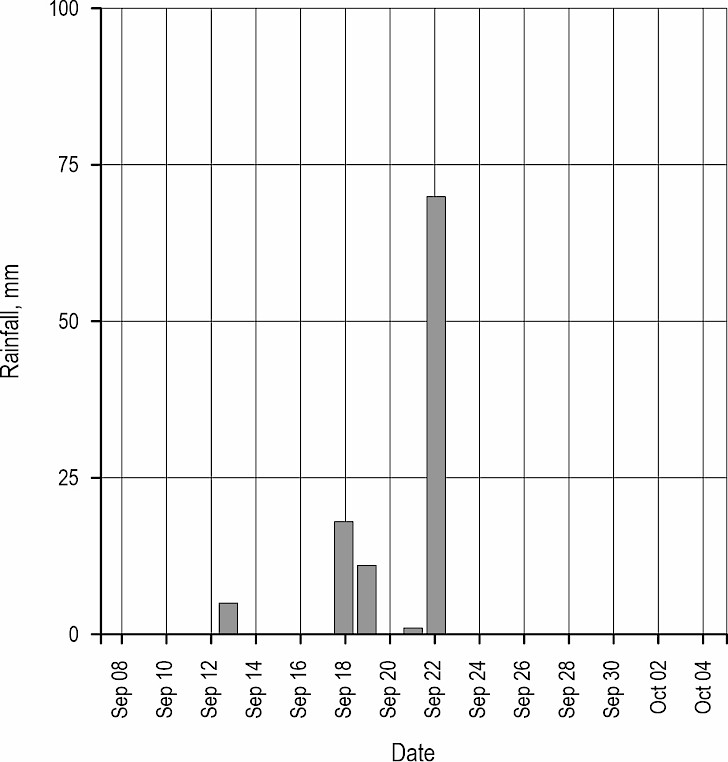
Fig. A1 Rainfall precipitation within the study period considered
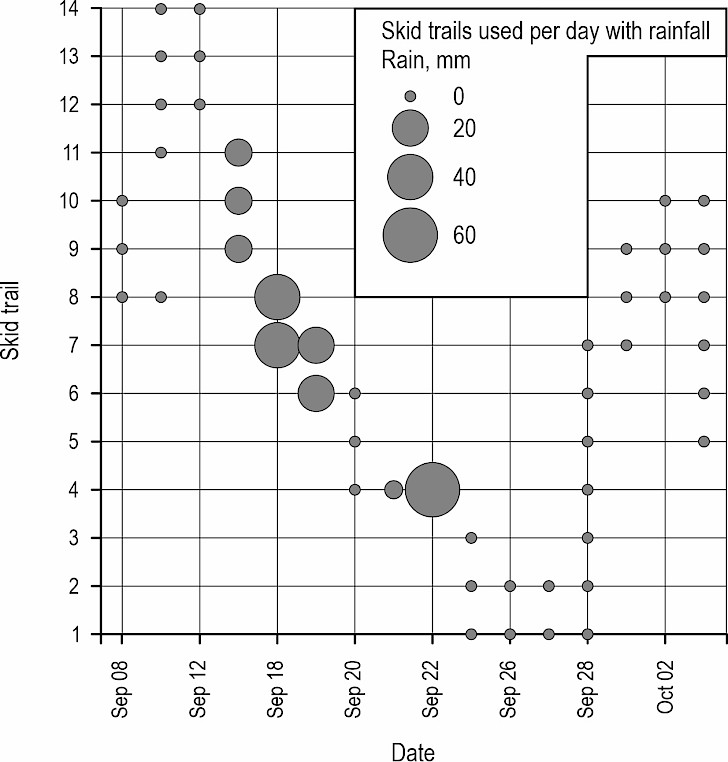
Fig. A2 Total rainfall and skid trails used during the same day
Table A1 Mann-Whitney U Statistic results for significant differences in rainy and no rain conditions over selected skid trails operated during rainfall events and without them
© 2026 by the authors. Submitted for possible open access publication under the
terms and conditions of the Creative Commons Attribution (CC BY) license (http://creativecommons.org/licenses/by/4.0/).
Authors’ addresses:
Filippo Guerra, PhD
e-mail: filippo.guerra@phd.unipd.it
Università degli Studi di Padova
Department of Land, Environment, Agriculture and Forestry
Viale dell’Università 16
35020, Legnaro (PD)
ITALY
and
Forest Education Center (FBZ) – Center for Forest and Timber
Industry, State Enterprise for Forestry and Timber NRW
Alter Holzweg 93
59755, Arnsberg-Neheim
GERMANY
Prof. Thilo Wagner, PhD
e-mail: thilo.wagner@wald-und-holz.nrw.de
Forest Education Center (FBZ) – Center for Forest and Timber
Industry, State Enterprise for Forestry and Timber NRW
Alter Holzweg 93
59755, Arnsberg-Neheim
GERMANY
Alberto Udali, PhD *
e-mail: alberto.udali@unipd.it
Prof. Francesco Marinello, PhD
e-mail: francesco.marinello@unipd.it
Università degli Studi di Padova
Department of Land, Environment, Agriculture and Forestry
Viale dell’Università 16
35020, Legnaro (PD)
ITALY
Prof. Stefano Grigolato, PhD
e-mail: stefano.grigolato@unipd.it
Università degli Studi di Padova
Department of Land, Environment, Agriculture and Forestry
Viale dell’Università 16
35020, Legnaro (PD)
ITALY
and
University of Stellenbosch
Faculty of AgriSciences
Dipartment of Forest and Wood Science
Paul Sauer Building Bosman Street
7600 Stellenbosch
SOUTH AFRICA
* Corresponding author
Received: June 25, 2025
Accepted: March 18, 2026
Original scientific paper