
Use of a Passive Shoulder Exoskeleton for Pruning Operations in Forestry – A Pilot Study
doi: https://doi.org/10.5552/crojfe.2027.4944
volume: issue, issue:
pp: 15
- Author(s):
-
- Kopetzky Marius
- Brokmeier Henrik
- Jaeger Dirk
- Weidner Robert
- Article category:
- Original scientific paper
- Keywords:
- (human) support, heart rate, ergospirometry, electromyography, physical strain, reach height pruning
Abstract
HTML
Forest workers often face repetitive and strenuous work tasks, leading to a high rate of musculoskeletal disorders and therefore incapacity for work. Most pronounced are pain as well as wear and tear in the lower back and the joints of knees and shoulders. Exoskeletons have already shown potential in reducing physical strain in various industries. Therefore, this pilot study aimed to investigate the usability and range of effects of a passive shoulder exoskeleton on forest workers during pruning operations in forestry to improve work conditions and reduce physical strain. Three healthy probands performed pruning tasks on Douglas fir trees in alternating sessions with and without the exoskeleton. Productivity, physical load, and muscle activity were assessed. Differences in working speed and productivity were observed among probands, but no correlations between exoskeleton use and productivity. Furthermore, no clear effect of exoskeleton use on heart rate or oxygen uptake was found. Electromyographic measurements indicated reduced muscle activity in three investigated shoulder muscles when wearing the exoskeleton. The anterior deltoid muscle of proband 3 shows the most significant response with a reduction of 39.9%, whereas the middle deltoid of probands 1 and 2 exhibits the greatest effect, with reductions of 14.5% and 14.0%, respectively. When comparing upward and downward arm movements specifically, the deltoid muscle activity (both anterior and middle) is reduced most effectively during downward movements. This reduction is most pronounced in proband 3, with a 56.5% decrease in the anterior deltoid, and in proband 1, with a 39.8% decrease in the middle deltoid. However, one proband exhibited noticeably increased loads in the upper trapezius muscle while wearing the exoskeleton, independent of the arm movement direction. This pilot study suggests that the passive shoulder exoskeleton has the potential to reduce muscle activity during pruning operations in forestry. Nevertheless, additional strain noticed in individual muscles as a result of unfavourable movement patterns need further investigations.
Use of a Passive Shoulder Exoskeleton for Pruning Operations in Forestry – A Pilot Study
Marius Kopetzky, Henrik Brokmeier, Dirk Jaeger, Robert Weidner
https://doi.org/10.5552/crojfe.2027.4944
Abstract
Forest workers often face repetitive and strenuous work tasks, leading to a high rate of musculoskeletal disorders and therefore incapacity for work. Most pronounced are pain as well as wear and tear in the lower back and the joints of knees and shoulders. Exoskeletons have already shown potential in reducing physical strain in various industries. Therefore, this pilot study aimed to investigate the usability and range of effects of a passive shoulder exoskeleton on forest workers during pruning operations in forestry to improve work conditions and reduce physical strain. Three healthy probands performed pruning tasks on Douglas fir trees in alternating sessions with and without the exoskeleton. Productivity, physical load, and muscle activity were assessed. Differences in working speed and productivity were observed among probands, but no correlations between exoskeleton use and productivity. Furthermore, no clear effect of exoskeleton use on heart rate or oxygen uptake was found. Electromyographic measurements indicated reduced muscle activity in three investigated shoulder muscles when wearing the exoskeleton. The anterior deltoid muscle of proband 3 shows the most significant response with a reduction of 39.9%, whereas the middle deltoid of probands 1 and 2 exhibits the greatest effect, with reductions of 14.5% and 14.0%, respectively. When comparing upward and downward arm movements specifically, the deltoid muscle activity (both anterior and middle) is reduced most effectively during downward movements. This reduction is most pronounced in proband 3, with a 56.5% decrease in the anterior deltoid, and in proband 1, with a 39.8% decrease in the middle deltoid. However, one proband exhibited noticeably increased loads in the upper trapezius muscle while wearing the exoskeleton, independent of the arm movement direction. This pilot study suggests that the passive shoulder exoskeleton has the potential to reduce muscle activity during pruning operations in forestry. Nevertheless, additional strain noticed in individual muscles as a result of unfavourable movement patterns need further investigations.
Keywords: (human) support, heart rate, ergospirometry, electromyography, physical strain, reach height pruning
1. Introduction
The range of tasks performed by forest workers is diverse, and their profession was and still is characterized by dangerous working environments and high physical stress (Lewark 1990, Cheţa et al. 2018, Choina et al. 2018, Dimou et al. 2020). In addition, forced postures cannot always be avoided, as well as lifting heavy weights, i.e., chain saws, fuel canister, splitting hammer or mechanical felling wedges (Harstela 1990, Hoffmann and Jaeger 2021). As a consequence of the fatiguing physical demands, a relatively high rate of serious or even fatal work accidents occur (Lilley et al. 2002), as well as musculoskeletal health issues. For example, approximately 45% of German forest workers suffer from low back pain (Lewark 1990, Meier 1999, Rudolph 2013, Klugmann et al. 2020). Other studies have similarly shown that forest workers in various countries frequently experience pain in the back, knees, shoulders, and neck (Gallis 2006, Lagerstrom et al. 2019, Boocock et al. 2023). The proportion of forest workers who remain in their jobs until regular retirement age is low compared to other industries (Lewark 1990). This is of high relevance given the high average age of forest workers, ranging between 47 and 58 years, and the already noticeable shortage of skilled workers in this sector (Deutscher Forstverein e.V. 2023).
Tasks involving increased physical stress and forced postures can be found among various planting, tending and pruning methods as well as motor-manual tree felling and processing (Forstliche Bildungsstätten der Bundesrepublik Deutschland 2019). Despite a high rate of mechanization, these tasks will continue to be of great importance in the future, and their share of the daily working time of forest workers will even increase in some cases. For example in Germany, where large areas have been deforested by storms, long dry periods, and resulting bark beetle infestations since 2018 (Federal Statistical Office 2020), there is a need for reforestation by mechanized and manual planting in the coming years. This will be followed by an increasing volume of tending work of upgrown reforested stands, in order to support the stem development and dimensioning of trees in a target-oriented manner. Furthermore, pruning is important for tree species such as Douglas fir (Pseudotsuga menziesii Franco), which are increasingly introduced in the course of silvicultural strategies for adaption to climate change, if high dimensional and high quality timber is a production aim. This applies to all tree species that are known for keeping dead branches, namely Silver fir (Abies alba Mill.), Sweet cherry (Prunus Avium L.) (Weller 2019). Besides that, forest restructuring to unevenly aged forests with a high proportion of hardwoods, increasingly results in harvesting conditions in which motor-manual felling and processing is preferable for flexible smallscale management compared to fully mechanized harvesting (Berendt et al. 2017).
Practical use case studies in other industries show that exoskeletons can help reduce the physical strain on workers, making the workplace less stressing and more attractive (Hensel and Keil 2018, Gillette and Stephenson 2019), which could contribute to solve the abovementioned problem of shortage of skilled forest workers and their aging demographics.
Exoskeletons are considered active when they use an external energy source, mainly electricity or air pressure (i.e. pneumatic activation), to support movements. Passive exoskeletons on the other hand do not depend on an external energy source, but store muscle energy in elements like springs or elastic bands when moved in a certain direction, to redistribute it while moving in the opposite direction. The resulting effect can be used to enable, facilitate, reinforce, stabilize or supplement movements (Karafillidis and Weidner 2018). In the case of adapting industrial exoskeletons to forest work tasks, reinforcement and stabilization of movements would be of interest to reduce muscle strain as well as wear and tear in joints, probably induced by non-ergonomic movements and postures.
The effects of using passive exoskeletons can be diverse and have already been investigated in several studies in other sectors and for different body parts (Settembre et al. 2020, Bär et al. 2021). Exoskeletons aim at reducing strain on muscles and joints they support, and thus reduce muscle activity (Alabdulkarim et al. 2019, Alabdulkarim and Nussbaum 2019, Kim and Nussbaum 2019, Schmalz et al. 2019b, van Engelhoven et al. 2019, Iranzo et al. 2020, Maurice et al. 2020, Pacifico et al. 2020, Yin et al. 2020, de Bock et al. 2021, Rossini et al. 2021), muscle fatigue (Schmalz et al. 2019b), in some cases heart rate and energy consumption (Schmalz et al. 2019b, Maurice et al. 2020) and presumably wear and tear on joints (Fritzsche et al. 2021). All this depends on the devices’ design, supported body parts and support strength (van Engelhoven et al. 2019, de Bock et al. 2021). It can be assumed that this will increase productivity and job satisfaction (Alabdulkarim and Nussbaum 2019, Smets 2019), while reducing physical and mental ailments and pain during manual work. Passive shoulder exoskeletons developed for industry and used in, e.g., the automotive sectors (Schmalz et al. 2019a, Schmalz et al. 2019b, Maurice et al. 2020, Ottobock Industrials 2021), could also be considered for overhead work tasks with forced awkward postures in forestry, such as reach height pruning, although there are differences in the dynamics of the tasks and handled weight.
Whether exoskeletons will become established in the forestry sector particularly depends, besides comfort in use, on their potential to reduce muscle activity in wear and tear prone joints and their suitability for use under the demanding and different forest working conditions. While the relieving effect of passive shoulder exoskeletons has already been demonstrated in short laboratory test sequences, for example by Schmalz et al. (2019b) or van Engelhoven et al. (2019), with simple movement patterns and in controlled environments, de Bock et al. (2021) already highlighted the differences in effects between in-field and laboratory evalutations of exoskeletons. Furthermore, most passive exoskeletons are designed to support mainly static work tasks (Baldassarre et al. 2022). Hence, their cumulative effect on shoulder muscles over longer series of measurements and their effect on physical load and mobility during dynamic work tasks in common forest conditions has yet to be investigated.
Therefore, as a first approach to investigate the usability of exoskeletons in silvicultural environments, a passive shoulder exoskeleton was tested on three selected forest workers in a pruning operation of Douglas fir. The pilot study aimed at testing the overall usability of the exoskeleton in confined work spaces of forest stands as well as measuring key values of exoskeleton research and comparing the in-field effects of three very different probands with laboratory results of the literature review. In particular, the relieving effect of the shoulder exoskeleton on physical load of the forest workers was investigated, as some studies found a reduction in physical load (Schmalz et al. 2019a, Schmalz et al. 2019b, Maurice et al. 2020) during laboratory testing, while others found an increase (Baltrusch et al. 2018) when using passive exoskeletons. Furthermore, muscle activity was recorded for an extended period of time and during complex motion sequences in order to investigate the cumulative effect of the passive shoulder exoskeleton, as laboratory studies have mostly investigated the effects during short-duration and simple movements. And finally, the range of effects on very different forest workers was investigated, in order to test the limits in usability for possible forest worker end users.
2. Materials and Methods
This pilot study was conducted at the end of July and beginning of August 2021, in three homogeneous 18 years old Douglas fir stands, mixed with Spruce (Picea abies, L.) and Beech (Fagus sylvatica, L.) trees without understory. Each forest stand covered an area of 1.0 to 2.0 hectares in the Harz Mountains in the German federal state of Lower Saxony. The soil is moderately to slightly nutrient-poor, consisting of silty-loamy covers, including loess loam or solifluction layers over base-poor silicate bedrock. The selected test plots within these areas were located in the upper section, in a very gently sloping terrain transitioning into level ground (plateau). Air temperature ranged between 11 °C and 15 °C with a relative air humidity between 63% and 94%. The objective of the task was to conduct pruning on 80 to 100 marked Douglas fir trees per hectare. The pruning operation employed a specific work method known as reach height pruning. In this approach, using a pruning shear, all branches were systematically removed from the ground extending up to the reach height, which varied based on the proband’s body size and typically reached around 2.2 meters (Fig. 1). The forest workers are particularly exposed to strain on the neck, arm and shoulder muscles during this partly overhead work, as a result of the head inclination and arm positioning when reaching up to maximum height (Fig. 1 A–C). Therefore, this working method can be assumed as dynamic, according to ISO definition (International Organization for Standardization 2000).
For the tests, a F3015 cut-supporting pruning shear (INFACO, Cahuzac sur Vère, France) was used, connected via a cable to a battery, which was attached to the hip belt of the exoskeleton, when it was worn (Fig. 1A), or was otherwise worn in a holster on the belt. The total weight of the battery and shear was around 1.8 kg. The passive exoskeleton PAEXO Shoulder (Ottobock, Duderstadt, Germany), with a weight of 1.9 kg (Fig. 1A), was used during the pruning operations. It has been developed specially for industrial applications of long-term overhead work (Ottobock Industrials 2021) with a maximum support when the arms are elevated to around a 90° angle, until zero support when the arms are lowered parallel to the side of the body. The exoskeleton can be fitted to anthropometric dimensions of users and the support strength can also be continuously adjusted to the user’s needs via change of the lever arm length (Schmalz et al. 2019a).
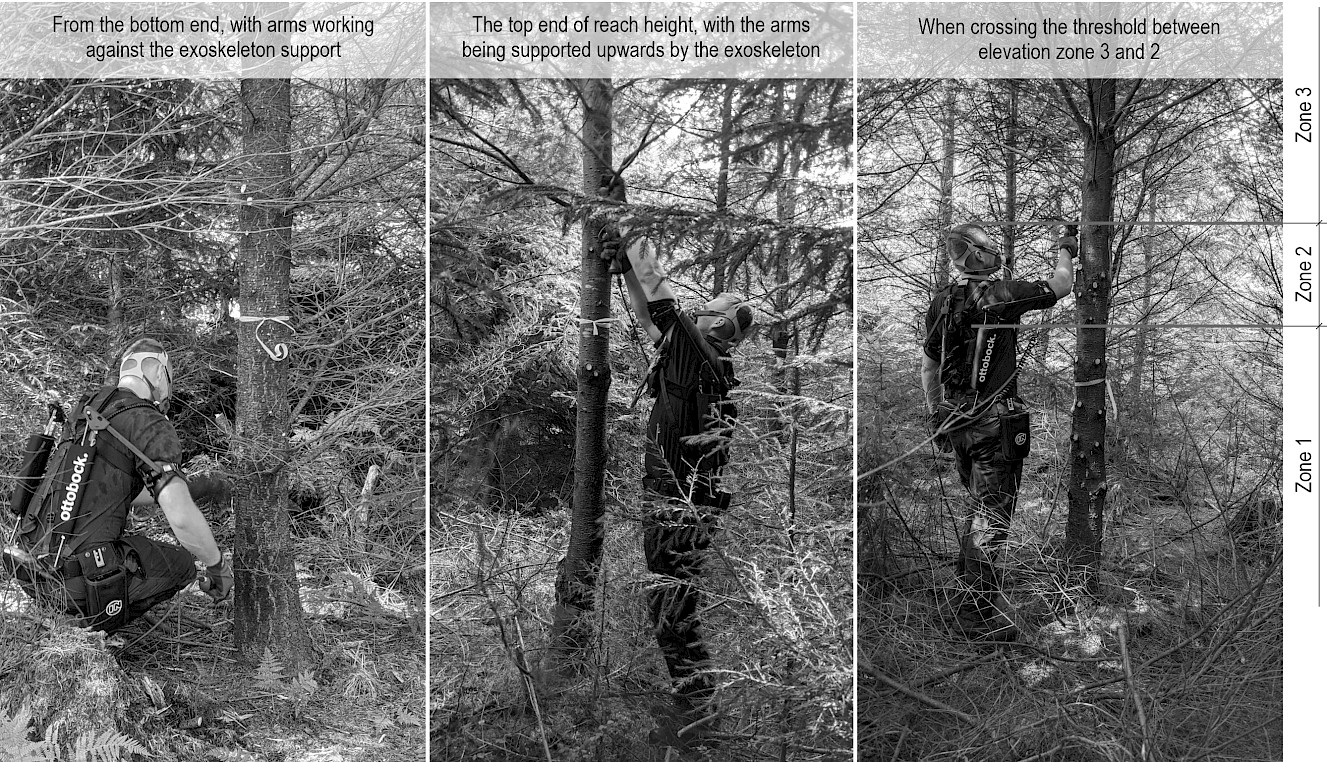
Fig. 1 Performing the pruning task
For arm support, rubber expanders pull vertically, parallel to two aluminium rods attached to a hip belt, permanently at the short end of aluminium rods attached horizontally to it. These horizontal rods run parallel to the upper arms, with a plastic shell at the long end which is pressed upwards by the leverage effect of the pulling rubber expanders.
The arms can be placed in the plastic shells, just above the elbow, so that the shoulders have to exert little or no force of their own, depending on the support setting selected. For mainly static overhead work, the lifting force of the exoskeleton is selected so that the mass of the arms, plus the tools used is transferred almost completely to the hips and the shoulder muscles are nearly not activated. However, in the case of the investigated dynamic work procedure, such a setting with maximum support would have been a hindrance due to the required movement up and down the tree trunks, so that the individually selected support strengths of the exoskeleton were significantly lower (Table 1).
Table 1 Data of probands and relative exoskeleton support strength

Three healthy probands from the Lower Saxony state forest company were selected based on their diversity, i.e., gender, physique and age. In accordance to the Helsinki Declaration and the guidelines of the ethics committee of the Georg-August-University Göttingen, the probands were fully informed about the study procedure, the recorded data, and scientific background as well as their rights as participants. All probands signed a declaration of consent and gave permission to the authors to collect and analyze the anonymized data. For detailed information about the probands seeTable 1. In terms of handiness proband 3, though he was left-handed, preferred using the shear with his right hand while he used his left hand to rip off small twigs.
None of the probands was familiar with the use of exoskeletons before the tests. All probands worked on a trial basis before starting the testing for a couple of minutes to get accustomed to the pruning shear and to select a suitable support strength and fitting for the exoskeleton which remained unchanged for each proband during the field trials.
Each proband worked with a self-chosen speed and order of trees for 60 minutes per session. Proband 1 worked three sessions (Sessions 1, 2, 3) on the first day and two sessions (Session 4, 5) on the second day. The sessions were conducted in two alternating variants, either with or without wearing the exoskeleton. After every session the probands had to sit down and rest to lower their heart rate and physical stress to a calm state.
For the analysis of whole-body physical strain during work with or without the exoskeleton, a MetaMax 3B (Cortex Medical, Leipzig, Germany) ergospirometry unit was used (Fig. 2A). Ergospirometry is a method for deriving the internal energy metabolism and demand based on the breath-by-breath analysis of respiratory gas composition and respiratory gas volume per time during dynamic physical activities. Therefore, every proband wore a tightly fitting plastic mask with a disposable fan and was connected to a gas sensor to measure the volume of inhaled air per time unit and the volume and composition of exhaled breath. The gas sensor was calibrated with ambient air every day before testing, according to software demands. In addition, the probands wore a chest strap of the type T-31 Coded from the manufacturer Polar to monitor heart rate. The chest strap transmitted heart rate data via Bluetooth to the MetaMax 3B unit in real-time. Prior to the start of the first session, the basal metabolic rate and resting heart rate of the probands were recorded in a seated position for reference purpose (Kroidl et al. 2015).
Outliers of heart rate data were removed by reducing those to the highest possible value using the formula of Tanaka et al. (2001).
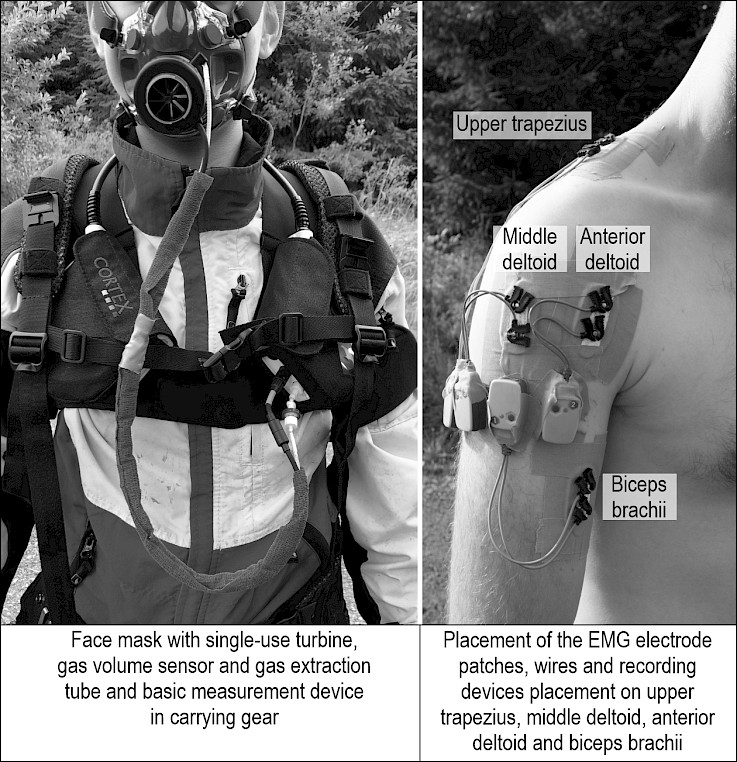
Fig. 2 Measurement system for ergospirometry
The electromyography (EMG) device NORAXON Ultium EMG (NORAXON, Scottsdale, Arizona, USA), together with the software myoResearch, version 3.18.04, was used to measure muscle activity of selected muscles during the comparative test series. The NORAXON dual surface sensors record the electrical voltage of selected muscles and thus provide information about the degree of tension of these muscles.
During the experiments, sensors were attached to the deltoid (anterior (AD) and middle (MD)), biceps brachii and upper trapezius (UT) muscles on the side with which the probands wielded the pruning shear. The contact areas for the sensors were shaved and cleaned with alcohol before sensor application. All sensors were taped with medical fixation plasters, to avoid tear-off during the pruning operation, and connected to data loggers via cables (Fig. 2B). Muscle activity was recorded at a rate of 2000 Hz, following the SENIAM recommendations (Roessingh Research and Development BV 1999).
In addition, the probands were video taped throughout the test series with a Logitech camera that was attached to the measurement laptop; the video feed was directly integrated into the myoResearch software. The recorded video footage allowed for the placement of markers in the data series afterwards, enabling a clear differentiation in muscle activity between walking phases and the actual pruning work. Furthermore, three arm elevation zones were separately marked (Fig. 1C) to compare muscle activities when raising or lowering the arm at different angles, in both variants. At zone 1, the tool hand was moved from the bottom to chest height, at zone 2 it was between chest height and skullcap hight, and zone 3 involved all tool hand movements above the head (Fig. 1C).
The EMG raw data was initially subjected to a Butterworth-Filter of 6th order with a cutoff frequency between 20 and 500 Hz, then rectified and smoothed using an RMS filter with a window size of 100 ms. Due to technical issues during the Biceps brachii measurements and because of erroneous values of the other muscles during half of the sessions, Biceps brachii and other affected EMG data had to be taken out of further consideration.
The comparison of values focuses solely on the pruning activity, as it was assumed that the exoskeleton would have no relevant impact during the walking activity.
To compute muscle activity when a proband was raising the arm at a definite height, the change in the marker number (crossing the threshold) from lower to higher digits was filtered together with 600 consecutive measurement points (corresponds to 600 ms). The same procedure was used in opposite direction for lowering the arm. Through this, a focused analysis of muscle activity in the shoulder when raising or lowering of the arm at comparable heights was possible for two heights each, with and without the exoskeleton (Fig. 3).
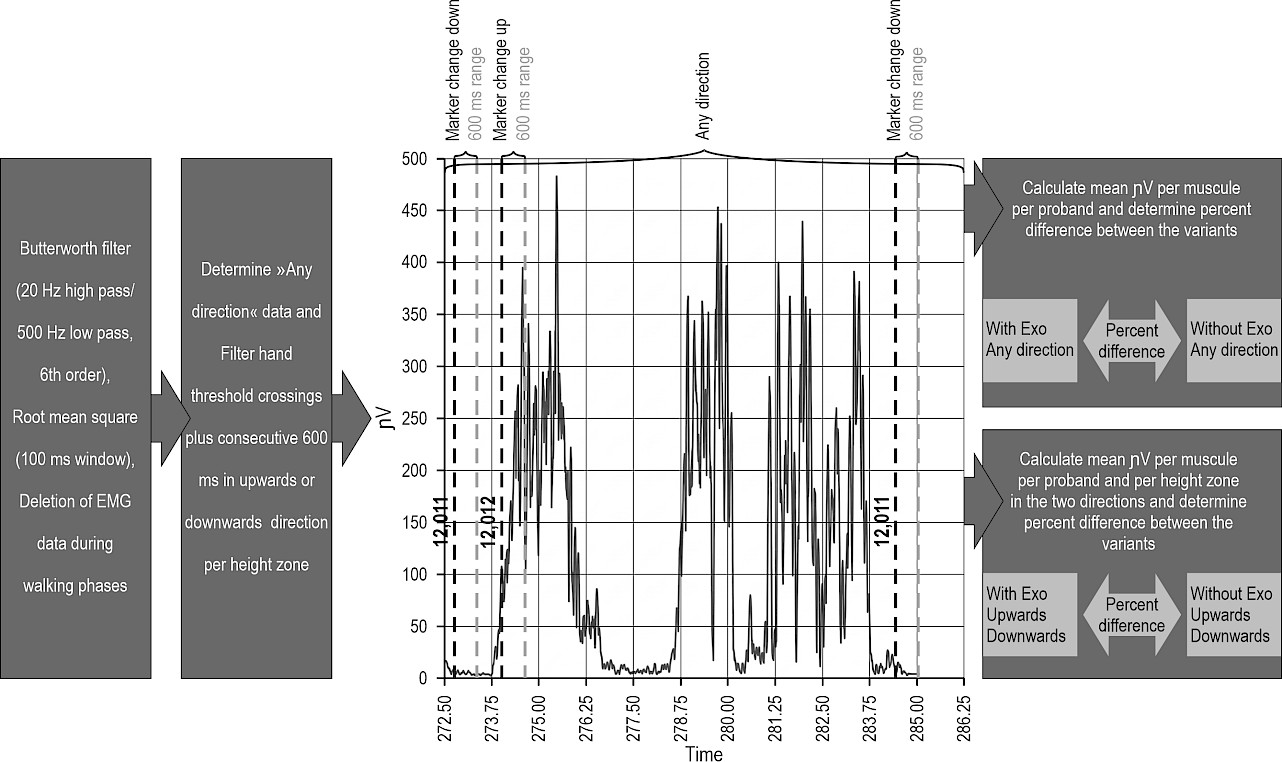
Fig. 3 Draft of data computing procedure to determine the three movement directions (Any direction, Upwards and Downwards) for variant (with exoskeleton versus without exoskeleton) comparison
Within-proband differences in physical load were analyzed using Kruskal–Wallis tests for session effects and Wilcoxon rank-sum tests for exoskeleton variant effects. For sEMG analyses, Wilcoxon rank-sum tests were used for the »Any Direction« approach, whereas movement-zone and movement-direction effects were analyzed using linear models fitted to log-transformed sEMG data. Due to the absence of sEMG normalization, no statistical comparisons across participants or muscles were conducted. Because of the pilot character of the study with a small sample size (n=3) of heterogeneous probands, statistical analyses were conducted for exploratory purposes only to highlight potential patterns and differences, and should be interpreted with caution. Instead, findings should be considered primarily in comparison with previous studies. For changes in productivity of the pruning method, comparisons were made with the results of Nutto et al. (2013) and Schönauer et al. (2021). For comparison with results of laboratory studies mainly Schmalz et al. (2019a), Schmalz et al. (2019b) and Maurice et al. (2020) were considered, as they investigated a similar passive exoskeleton for physical load and muscle activity. These comparisons aim to find similarities or major differences, using a passive exoskeleton for manual work in forests.
3. Results
3.1 Productivity
Table 2 gives an overview of the number of sessions, the variants and the performance of the three probands during the whole pruning operations in chronological order. The number of pruned trees varies between 11 and 33 across all probands, depending on respective work speed and treated stem length, while the duration of assessment was supposed be at least 60 minutes for all sessions. However, the second session of the first proband and the third session of the third proband were only 48 minutes long, due to technical issues.
Table 2 Performance per proband and variant
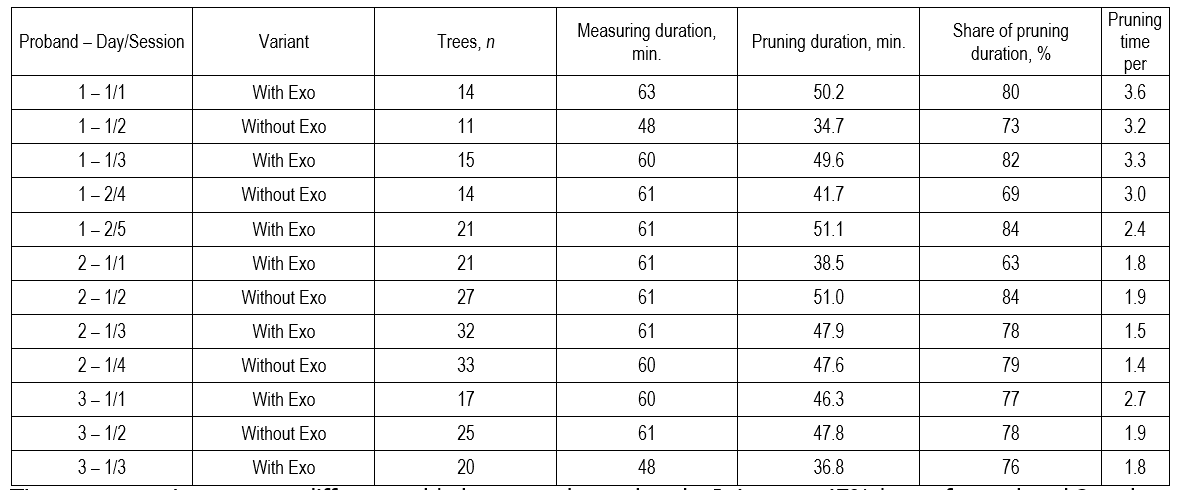
Time consumption per tree differs notably between the probands. It is up to 47% lower for proband 2 and up to 33% lower for proband 3 than for the first proband.
Furthermore, Table 2 shows the proportion of pruning as a share of the measuring duration, while the remaining time would be time taken to find and approach the trees by walking. The corresponding values are at a comparable level over all probands and variants, only the last session of the first proband shows a notably shorter pruning time per tree as well as a higher share of pruning duration compared to the previous sessions of the same proband.
3.2 Physical Load
Fig. 4 provides heart rate and oxygen uptake of the three probands per session as well as per variant. No statistically significant session or variant effects were detected for heart rate or oxygen uptake. Although there were noticeable differences between the variants in the individual sessions in some cases, the comparison of median values also shows noticeable differences between individual sessions within the same variant. Across all sessions, no consistent exoskeleton-related effects were evident for any of the probands. Similar to the productivity results, the last session of the first proband shows slightly lower heart rates and oxygen uptake values compared to the previous sessions.
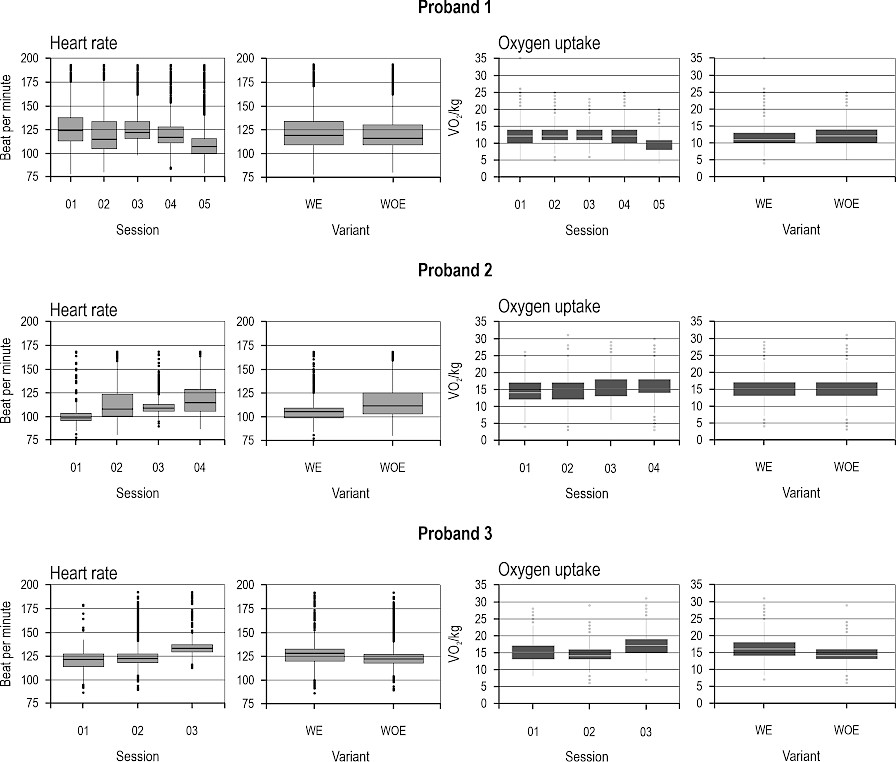
Fig. 4 Heart rate (bpm) and oxygen uptake (VO2/kg) per proband, broken down by sessions (left) or variant (right)
3.3 Muscle Activity
As shown in Table 3, most of the pruning was carried out in height zone 1, from the ground up to chest height, whereas only a small proportion of work was performed in zone 3, above head height. Probands 2 and 3 showed comparable work ratios across the three zones, while proband 1 worked notably more in height zones 2 and 3.
Table 3 Ratio of work done per height zone during the sessions used for EMG-analyzation
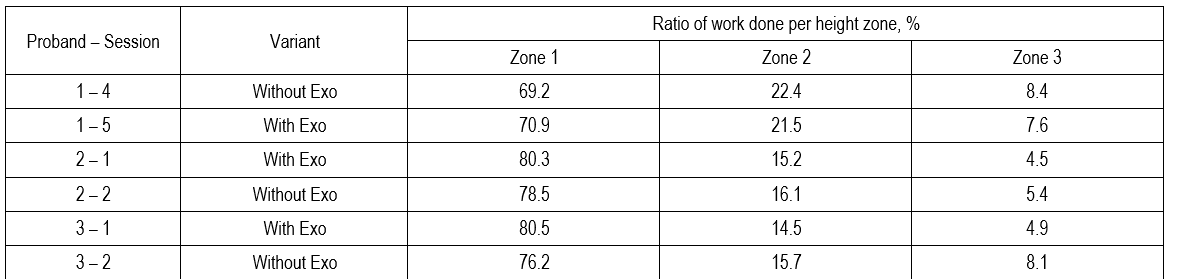
Fig. 5 shows the results of mean microvolt (µV) changes calculated from the sessions with the exoskeleton against those without the exoskeleton during the whole pruning process (any direction), excluding walking, on the anterior deltoid (AD), middle deltoid (MD) and upper trapezius (UT) muscles. The same was calculated and is given here for when the arm was moved upwards or downwards at the two hand height thresholds. The number of trees (N) included in the »Any Direction« analysis is shown in the upper left corner for sessions with exoskeleton (WE) and without exoskeleton (WOE). The degrees of freedom (df) of the linear models are given for upward and downward movement analyses.
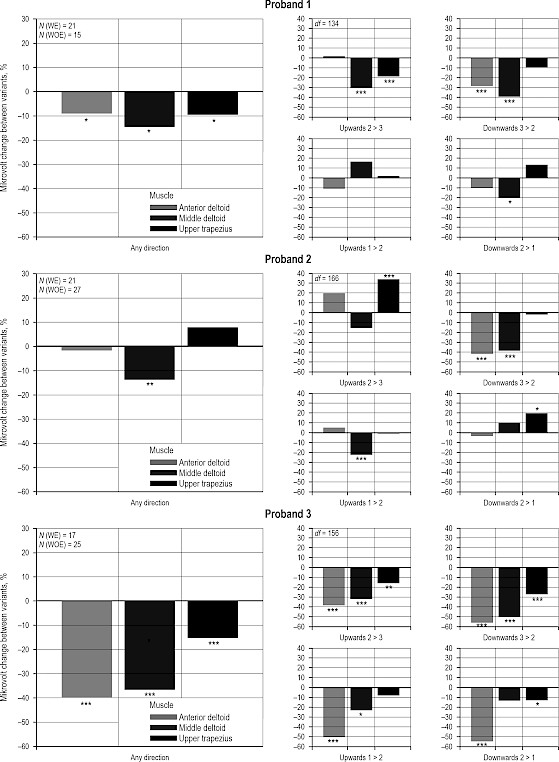
Fig. 5 Mean percentage change in muscle activity (µV) of AD, MD and UT per proband due to exoskeleton use, over the whole pruning process (Any direction) as well as broken down by arm movement directions at two hand height thresholds (Upwards 1>2, 2>3; Downwards 3>2, 2>1). Levels of significance are given as <0.001: »***«; <0.01: »**«; <0.05: »*«
When analyzing relative changes of mean µV through the use of the exoskeleton in any arm direction, all three probands show significant reductions across almost all monitored muscles. Only the delta of the mean value of the UT of proband 2 shows a reverse effect, which is not significant, as is the AD of the same proband. Highly significant differences occured across all the examined muscles of the third proband.
Furthermore, while for the third proband the effects are most distinctive in the anterior deltoid with a reduction of 39.9%, the other probands show most pronounced changes in the middle deltoid with a reduction of 14.5% in proband 1 and 14.0% in the second proband.
Differences in relative muscle activity through the use of the exoskeleton also occured when up or down movements of the arm were selectively compared. Only in downwards movements from overhead to head height (3>2), the shoulder muscle activity is significantly reduced in all of the probands. The other movement directions and hand heights, however, show a mixed picture for proband 1 and 2 with decreases as well as even significant increases in percent muscle activity difference between the variants.
4. Discussion
4.1 Productivity
It appears that the exoskeleton had no noteworthy effect on either of the three probands in terms of time consumption per tree. The reasons for the obvious differences in working speeds in the sessions within each proband as well as between the probands may include the different procedures and differences in the care taken, for example, to remove all small branches. Other possible causes are varying fitness levels, anthropometrics and other gender related differences, and the effect, which cannot be ruled out in part, of increased motivation to work faster than would be the case during normal operation as a result of observation during the time study. However, time consumption per tree is comparable to results with the same pruning shear in a study of Schönauer et al. (2021), though proband 2 worked faster and proband 1 needed more time per tree. The findings of Nutto et al. (2013), who investigated a slightly different electric shear (INFACO 3010), fit between these two probands.
4.2 Physical Load
The use of the ergospirometry unit for respiratory gas analysis and the chest strap for heart rate measurements was largely trouble-free under the demanding conditions that can be found during pruning operations in dense forest stands. The fact that no clear significant differences or tendencies could be found in either of the three probands in terms of heart rate or relative oxygen uptake when working with or without the exoskeleton may have different reasons apart from their physiques. The working method is already not very strenuous with the light cordless pruning shears, including electric cutting release, which means that the stressing effects on the metabolism should already be significantly lower than, for example, when pruning with a pole saw. Schönauer et al. (2021) have found that using an electric pruning shear already reduces percent heart rate reserve (%HRR) significantly compared to other pruning tools, and therefore this pruning work counts as »light work«. Also, in the studies of Nutto et al. (2013), a significantly reduced heart rate when using the INFACO 3010 compared to two other more muscle work demanding tools could be seen, which underpins the rating that the work with the INFACO shear is considered light work. Therefore, a relevant minimum level of strain, which is suggested by Mitterlehner et al. (2023), where differences through the use of an exoskeleton could be manifested, might not have been achieved in all probands of this study.
Another reason might be that, although the results of this study show a relief of certain muscles by the exoskeleton, at the same time additional strain can be assumed due to the additional weight of the applied exoskeleton as well as possibly occurring hindrances by the exoskeleton in the stand. Other studies (Schmalz et al. 2019a, Schmalz et al. 2019b, Maurice et al. 2020) have found a decrease in heart rate and oxygen uptake due to the use of the shoulder exoskeleton in largely static postures. Yet it must be noted that the overall degree of overhead work during the work process, where the use of the exoskeleton could affect physiological release, was rather low. In addition, other working elements of the work process, such as walking through a dense forest stand, activated big muscle groups in the legs which might cover up the releasing effect of the exoskeleton application. Comparably, Spinelli et al. (2015) found that terrain slope would mask the effect the device was expected to have on the probands in their study about a slack-pulling device meant to reduce physiological workload during log winching.
Furthermore, Baltrusch et al. (2018) even found an increase in metabolic consumption in their study of a passive trunk supporting exoskeleton, caused by movements against the support of the device. However, this seems not to apply in our study, as the muscle activity in the shoulder is mostly reduced when lowering the arm. Also, according to studies of van Engelhoven et al. (2019), Kim and Nussbaum (2019) and Iranzo et al. (2020), the other muscles normally used to lower the arm, namely latissimus dorsi and pectoralis major, are less active or at least experience only minor activation increases when working against the support of the exoskeleton.
4.3 Muscle Activity
The use of the surface EMG measurement technology under the demanding conditions in the forest led in part to sensor disturbances or failures, so that only six sessions (seeTable 3) instead of twelve could be considered in the analysis of the muscle activities. Furthermore, the duration of the measurements of about 60 minutes per session was chosen to reach a maximum possible physical strain as well as to analyze the muscle activity over a long and comprehensive working period. The occurrences of technical issues during that hour counteracted that intent in the way that measurement sessions under suspicion of erroneous data were removed completely and therefore led to only a limited number of useful data. This is why in future studies, to reduce the effect of sensor disturbances on a whole session, shorter durations are suggested. Lastly, presumably due to the pressure exerted on the sensors on the biceps brachii muscle by the straps fixing the arms to the arm shells, the recordings failed or provided implausible values and were therefore not analyzed at all.
The ratios of hand heights during pruning do show a difference between the probands. While the first proband worked more than 20% in the second zone and between 7.6 and 8.4% in the highest zone, the other two probands performed more work in zone 1 and did so in comparable proportions. The difference might be due to anthropometrics, as the first proband was 13 and 33 cm smaller than probands 2 and 3, respectively. Only in the session without the exoskeleton support did proband 3 work 8.1% in the highest zone. While the data suggest a slight tendency of 1% towards reduced work at heights above chest level (zones 2 and 3) when wearing the exoskeleton, it is insufficient to establish a clear trend.
When comparing the effects of the exoskeleton on the three muscles between the arm movement directions (any, up or down), the results differ notably between the movements in any direction versus the specified directions, especially in proband 2, but also in proband 1. This might be due to the fact that the upwards and downwards movements only correspond to 600 ms after threshold crossing and consider a clear direction of movement. In contrast, »any direction« covers several minutes per tree and includes both lifting and lowering movements as well as static holding.
Furthermore, the observed effects may in part be regarded as unexpectedly high, especially for proband 3. This is particularly true against the background of the dynamic nature of the work task whereas the exoskeleton is designed to support primarily during static overhead work, and the fact that most of the pruning was performed at chest height or lower. Proband 1 and 3 crossed the threshold at chest height two times more often than the one at head height, proband 3 even three times more often. That is why the influence of decreased muscle activity at head height on the overall muscle activity during pruning phases is relatively low. In contrast, Schmalz et al. (2019a), for example, conducted a study on relieving the shoulder muscles during simulated static overhead work with the same exoskeleton. They measured reliefs of 47% (anterior deltoid), 45% (middle deltoid) and 26% (upper trapezius) on average, with a much higher share of overhead work time.
However, as expected due to findings with the same exoskeleton(Schmalz et al. 2019a, Schmalz et al. 2019b, Maurice et al. 2020) as well as by several other studies (Huysamen et al. 2018, Alabdulkarim et al. 2019, Alabdulkarim and Nussbaum 2019, Gillette and Stephenson 2019, Kim and Nussbaum 2019, van Engelhoven et al. 2019, Iranzo et al. 2020, Pacifico et al. 2020, Yin et al. 2020, Fritzsche et al. 2021, Lee et al. 2024, Ramella et al. 2024), the deltoid muscle (AD and MD) of all three probands was unloaded by the exoskeleton during the pruning phases. The anterior part of the deltoid muscle in the shoulder is, among others, primarily responsible for lifting the arm parallel to the body forwards (Anteversion), whereas the middle deltoid enables the arm to be lifted sideways (Abduction) (Brinckmann et al. 2012). The activity of pruning with the cordless shear requires the forest workers to lift the arm forward, not stretching it straight forward, but also slightly outward, creating a flat angle in the crook of the arm. This activates both the anterior and the middle shoulder muscles, and both can be adequately supported by the passive exoskeleton during pruning operations. UT showed a mixed response to exoskeleton application. While two of the probands (first and third) showed, as expected, reduced activity of UT when applying the exoskeleton, the second proband showed the opposite effect. The reaction of UT of the second proband might have to do with an alternated movement pattern, due to wearing the exoskeleton. This means that the proband used the UT more, stimulated by the exoskeleton support, and by that the compared values, though extracted during the same movement phase, resulted from different muscle activity patterns of the UT. This indicates a methodological weakness caused by the natural environment and little degree of standardization in this use case study.
Increases of muscle activity due to exoskeleton use have also been found in other studies even with the same exoskeleton (Schmalz et al. 2019a, Schmalz et al. 2022, Lee et al. 2024) and therefore this is not unusual. All three studies investigated the effects of passive exoskeletons during static overhead drilling tasks but did not elaborate on increased muscle activity in the trapezius muscle, perhaps due to the small effect size.
When considering the muscle activation to lift or lower the arm in defined height zones, the exoskeleton seems to support the deltoid muscle most reliably in the downwards movement from overhead to head height. During this movement the highest decreases in AD and MD muscle activity occurred in all three probands. According to the force curve, the maximum support of the exoskeleton can be assumed around this height (Latella et al. 2021), because it was designed to support the arms during mostly static overhead work. This result is also well in line with findings of other authors who, however, used other exskeletons (Lee et al. 2024, Ramella et al. 2024). Ramella et al. (2024), for example, also found that muscle activity was lowered mostly in the deltoid muscle and also more during the downwards than the upwards movements, when using the Mate-XT passive exoskeleton.
Yet, the already mentioned ratio of work done at different hand heights must be emphasized again. A different exoskeleton design or adaptation of the exoskeleton used for more constant arm support over the entire working height range should be considered for this work task. Besides, muscle activitiy did also increase in some occasions, even significantly, during lifting or lowering of the arm, most notably in the UT muscle of proband 2. This might have to do with the exoskeleton design and its original purpose to support mostly static overhead work. The non-standardized study conditions could also have had an influence on this effect, as movement execution and speed affect muscle activity (Brinckmann et al. 2012).
Since Fritzsche et al. (2021) layed out in their study that the reduction of muscle activity occurs together with a reduced joint strain, this can also be assumed in general for the forest use case investigated in this pilot study, as mostly muscle activity reductions occured. However, it must be emphasized that effects of the exoskeleton on the antagonistic muscles to lower the arm, in our case against the support of the exoskeleton, are unclear. Furthermore, the reason for sometimes clearly different effects on the three investigated muscles of the three probands cannot be definitively assessed on the basis of the pilot study and should therefore be investigated in a more comprehensive approach, together with the antagonist reaction to the exoskeleton use. However, different individual approaches to the pruning process were observed during the experiments, resulting in different postures and thus strains on the muscular system. Other possible causes are different basic physical conditions of the probands as well as the individually made and sometimes clearly different support settings for the exoskeleton (cf. Table 1).
Nevertheless, in general, diversity in the probands is recommended to gain a broader insight in the variety of work patterns and resulting effects before applying an exoskeleton in practical use cases.
4.4 Study Limitations
The aim of this study was to investigate the usability of a passive shoulder exoskeleton with a forestry work task and in a typical environment, and also, to investigate the variablity of effects on physical load and muscle activity in very heterogeneous probands. Heterogeneity in this pilot case study concerned age (from 20 years to 55 years), weight (from 58 kg to 90 kg), size (from 160 cm to 193 cm), gender (2 males, 1 female), handedness (left and right handed), and experience with the work method (from none to months). However, study limitations arise from this heterogeneity as well as from the small number of probands. For example, significance of differences should not be calculated across probands (as was not done here), and also probands interpretations of the calculated results should be taken with caution.
Wollesen et al. (2024) have found differences in the effects of a passive shoulder exoskeleton in an overhead drilling task between males and females, assuming influences by anthropometrics and body composition. The influence by anthropometrics and gender is also mentioned in a systematic review concerning side-effects of shoulder– and back-support exoskeletons by Kranenborg et al. (2023). Therefore, results from probands differing in gender or anthropometric characteristics should be interpreted separately.
Furthermore, absolute muscle activity values should not be compared across probands, as even slight differences in electrode placement on the same muscle within the same proband are known to produce substantially different sEMG signal amplitudes (Steinhilber and Rieger 2013). Therefore, normalizing the data to a maximum voluntary contraction (MVC) or a reference voluntary contraction (RVC) before comparison is mandatory (Huebner et al. 2015). Due to the known influence of proband heterogeneity on the results, normalization was not conducted in this study.
Finally, since this pilot case study focused on usability of the exoskeleton for this work method, the support settings preferred by the probands were allowed, taking into account the differences in strength between probands (due to anthropometrics and gender), and the decision not to compare results across probands in the first place.
5. Conclusions
In conclusion, this study explored the potential of one passive shoulder exoskeleton in reducing physical strain during pruning operations in forestry. The findings suggest that the investigated passive shoulder exoskeleton decreases muscle activity during a reach height pruning operation with an electric pruning shear, particularly in the anterior deltoid and middle deltoid muscles. However, no concluions can be drawn regarding the effects on heart rate or oxygen uptake when using a passive shoulder exoskeleton. The study also revealed variations in productivity and working speed among probands, indicating individual factors influencing task performance.
These results highlight the need for further research with larger sample sizes to confirm the benefits of exoskeleton application in forestry work. It is also crucial to conduct comprehensive investigations that encompass different forestry tasks to determine the optimal utilization of passive exoskeletons and their impact on workers health.
The application of exoskeleton technology in the forestry sector holds promise for improving work conditions, reducing physical strain, and potentially addressing the shortage and aging of skilled workers in this industry. However, careful consideration should be given to factors such as exoskeleton hardiness, individual fit, energy source, and task-specific requirements to maximize their effectiveness. For this, industrial exoskeletons need further research and development, i.e. to improve longevity in the forest environment. Future studies should also assess long-term effects, occupational safety considerations, and user acceptance to provide a more comprehensive understanding of the implications of exoskeleton implementation in forestry work.
Lastly, this study also contributes a potential methodological approach to investigate the effects of passive exoskeletons in practical forest use cases. In order to do so, measurement durations of around one hour were chosen as well as natural trees with varying numbers and orders of branches. This subsequently required a specialized post-hoc data analysis where very short (600 ms) excerpts of the EMG measurements were used to strengthen comparability of the results. However, future forest related practical use case studies of exoskeletons should further consider this comparability of movements.
Acknowledgments
This research was funded by the Eva Mayr-Stihl Stiftung, Germany and the Gesellschaft für forstliche Arbeitswissenschaft (GEFFA), Germany.
The authors want to thank the State Forest Administration of Lower Saxony for granting the personnel, forest stands and tools needed for this study. Special thanks go to the three probands of this study for their contributions.
Conflicts of Interest
The authors declare no conflict of interest. Also, the funders had no role in the design of the study, in the collection, analyses, or interpretation of data, in the writing of the manuscript, or in the decision to publish the results.
7. References
Alabdulkarim, S., Kim, S., Nussbaum, M.A., 2019: Effects of exoskeleton design and precision requirements on physical demands and quality in a simulated overhead drilling task. Appl Ergon 80: 136–145. https://doi.org/10.1016/j.apergo.2019.05.014
Alabdulkarim, S., Nussbaum, M.A., 2019: Influences of different exoskeleton designs and tool mass on physical demands and performance in a simulated overhead drilling task. Appl Ergon 74: 55–66. https://doi.org/10.1016/j.apergo.2018.08.004
Baldassarre, A., Lulli, L.G., Cavallo, F., Fiorini, L., Mariniello, A., Mucci, N., Arcangeli, G., 2022: Industrial exoskeletons from bench to field: Human-machine interface and user experience in occupational settings and tasks. Front Public Health 10: 1039680. https://doi.org/10.3389/fpubh.2022.1039680
Baltrusch, S.J., van Dieën, J.H., van Bennekom, C.A.M., Houdijk, H., 2018: The effect of a passive trunk exoskeleton on functional performance in healthy individuals. Appl Ergon 72: 94–106. https://doi.org/10.1016/j.apergo.2018.04.007
Bär, M., Steinhilber, B., Rieger, M.A., Luger, T., 2021: The influence of using exoskeletons during occupational tasks on acute physical stress and strain compared to no exoskeleton – A systematic review and meta-analysis. Appl Ergon 94: 103385. https://doi.org/10.1016/j.apergo.2021.103385
Berendt, F., Fortin, M., Jaeger, D., Schweier, J., 2017: How Climate Change Will Affect Forest Composition and Forest Operations in Baden-Württemberg–A GIS-Based Case Study Approach. Forests 8(8): 298–320. https://doi.org/10.3390/f8080298
de Bock, S., Ghillebert, J., Govaerts, R., Elprama, S.A., Marusic, U., Serrien, B., Jacobs, A., Geeroms, J., Meeusen, R., de Pauw, K., 2021: Passive Shoulder Exoskeletons: More Effective in the Lab Than in the Field? IEEE Trans Neural Syst Rehabil Eng 29: 173–183. https://doi.org/10.1109/TNSRE.2020.3041906
Boocock, M., Ashby, L., Parker, R., 2023: Musculoskeletal and work practice survey of chainsaw users in the New Zealand forest industry. Phys Ergon Hum Factors 103(103): 70–77.
Brinckmann, P., Frobin, W., Leivseth, G., Drerup, B., 2012: Orthopädische Biomechanik. Münster: Monsenstein und Vannerdat.
Cheţa, M., Marcu, M., Borz, S., 2018: Workload, Exposure to Noise, and Risk of Musculoskeletal Disorders: A Case Study of Motor-Manual Tree Feeling and Processing in Poplar Clear Cuts. Forests 9(6): 300. https://doi.org/10.3390/f9060300
Choina, P., Solecki, L., Goździewska, M., Buczaj, A., 2018: Assessment of musculoskeltal system pain complaints reported by forestry workers. Ann Agric Environ Med 25(2): 338–344. https://doi.org/10.26444/aaem/86690
Deutscher Forstverein e.V. 2023: Fachkräftemangel auch im Wald? https://www.forstwirtschaft-in-deutschland.de/aktuelles/news-detailansicht/news/fachkraeftemangel-auch-im-wald/ (Accessed July 29, 2025)
Dimou, V., Malesios, C., Pispa, S., 2020: Monitoring self-reported musculoskeletal symptoms in forestry operations. International Journal of Forest Engineering 31(2): 106–113. https://doi.org/10.1080/14942119.2020.1745530
Federal Statistical Office 2020: Forest damage due to drought: trees logged because of insect infestation nearly tripled in 2019 compared with 2018. https://www.destatis.de/EN/Press/2020/07/PE20_N041_412.html (Accessed October 19, 2021)
Forstliche Bildungsstätten der Bundesrepublik Deutschland, ed 2019: Beruf Forstwirt. Stuttgart (Hohenheim): Ulmer.
Fritzsche, L., Galibarov, P.E., Gärtner, C., Bornmann, J., Damsgaard, M., Wall, R., Schirrmeister, B., Gonzalez-Vargas, J., Pucci, D., Maurice, P., 2021: Assessing the efficiency of exoskeletons in physical strain reduction by biomechanical simulation with AnyBody Modeling System. Wearable Technol 2: e6. https://doi.org/10.1017/wtc.2021.5
Gallis, C., 2006: Work-related prevalence of musculoskeletal symptoms among Greek forest workers. International Journal of Industrial Ergonomics 36(8): 731–736. https://doi.org/10.1016/j.ergon.2006.05.007
Gillette, J.C., Stephenson, M.L., 2019: Electromyographic Assessment of a Shoulder Support Exoskeleton During on-Site Job Tasks. IISE Transactions on Occupational Ergonomics and Human Factors 7(3–4): 302–310. https://doi.org/10.1080/24725838.2019.1665596
Harstela, P., 1990: Work postures and strain of workers in Nordic forest work: A selective review. International Journal of Industrial Ergonomics 22(3): 219–226. https://doi.org/10.1016/0003-6870(91)90180-P
Hensel, R., Keil, M., 2018: Subjektive Evaluation industrieller Exoskelette im Rahmen von Feldstudien an ausgewählten Arbeitsplätzen. Z. Arb. Wiss. 72(4): 252–263. https://doi.org/10.1007/s41449-018-0122-y
Hoffmann, S., Jaeger, D., 2021: Insights on motor-manual tree felling in Germany, recent developments to ensure efficient operations in singletree selection harvest. European Journal of Forest Engineering 7(1): 39–44. https://doi.org/10.33904/ejfe.953226
Huebner, A., Faenger, B., Schenk, P., Scholle, H.-C., Anders, C., 2015: Alteration of Surface EMG amplitude levels of five major trunk muscles by defined electrode location displacement. J Electromyogr Kinesiol 25(2): 214–223. https://doi.org/10.1016/j.jelekin.2014.11.008
Huysamen, K., Bosch, T., Looze, M. de, Stadler, K.S., Graf, E., O'Sullivan, L.W., 2018: Evaluation of a passive exoskeleton for static upper limb activities. Appl Ergon 70: 148–155. https://doi.org/10.1016/j.apergo.2018.02.009
International Organization for Standardization 2000: ISO 11226: Ergonomics–Evaluation of static working postures 13.180. 11226. Berlin: Beuth.
Iranzo, S., Piedrabuena, A., Iordanov, D., Martinez-Iranzo, U., Belda-Lois, J.-M., 2020: Ergonomics assessment of passive upper-limb exoskeletons in an automotive assembly plant. Appl Ergon 87: 103120. https://doi.org/10.1016/j.apergo.2020.103120
Karafillidis, A., Weidner, R., eds 2018: Developing Support Technologies: Integrating Multiple Perspectives to Create Assistance that People Really Want. Cham: Springer International Publishing.
Kim, S., Nussbaum, M.A., 2019: A Follow-Up Study of the Effects of An Arm Support Exoskeleton on Physical Demands and Task Performance During Simulated Overhead Work. IISE Transactions on Occupational Ergonomics and Human Factors 7(3–4): 163–174. https://doi.org/10.1080/24725838.2018.1551255
Klugmann, K., Löwer, M., Sarferaz, E., 2020: Unfälle bei motormanuellen Fällarbeiten: Ergebnisse der Sondererhebung 2018/2019. Soziale Sicherheit in der Landwirtschaft 2: 5–22.
Kranenborg, S.E., Greve, C., Reneman, M.F., Roossien, C.C., 2023: Side-effects and adverse events of a shoulder- and back-support exoskeleton in workers: A systematic review. Appl Ergon 111: 104042. https://doi.org/10.1016/j.apergo.2023.104042
Kroidl, R.F., Schwarz, S., Lehnigk, B., Fritsch, J., Dumitrescu, D., Greiwing, A., Hager, A., Hollmann, W., Meyer, K., Schomaker, R., Tröschler, H.N., Wasserman, K., 2015: Kursbuch Spiroergometrie: Technik und Befundung verständlich gemacht. Stuttgart, New York: Georg Thieme Verlag.
Lagerstrom, E., Magzamen, S., Brazile, W., Rosecrance, J., 2019: Active Surveillance of Musculoskeletal Disorder Symptoms in the Development of Safety Interventions for Professional Loggers. Safety 5(2): 23. https://doi.org/10.3390/safety5020023
Latella, C., Tirupachuri, Y., Tagliapietra, L., Rapetti, L., Schirrmeister, B., Bornmann, J., Gorjan, D., Čamernik, J., Maurice, P., Fritzsche, L., Gonzalez-Vargas, J., Ivaldi, S., Babič, J., Nori, F., Pucci, D., 2021: Analysis of Human Whole-body Joint Torques during Overhead Work with a Passive Exoskeleton. IEEE Transactions on Human-Machine Systems 52(5): 1060–1068. https://doi.org/10.1109/THMS.2021.3128892
Lee, H.-H., Yoon, K.-T., Lim, H.-H., Lee, W.-K., Jung, J.-H., Kim, S.-B., Choi, Y.M., 2024: A Novel Passive Shoulder Exoskeleton Using Link Chains and Magnetic Spring Joints. IEEE Trans Neural Syst Rehabil Eng 32: 708–717. https://doi.org/10.1109/TNSRE.2024.3359658
Lewark, S., 1990: Arbeitssicherheit und Frühinvalidität bei Waldarbeitern. Forstarchiv 61: 99–102.
Lilley, R., Feyer, A.-M., Kirk, P., Gander, P., 2002: A survey of forest workers in New Zealand – Do hours of work, rest, and recovery play a role in accidents and injury? Journal of Safety Research 33(1): 53–71. https://doi.org/10.1016/S0022-4375(02)00003-8
Maurice, P., Camernik, J., Gorjan, D., Schirrmeister, B., Bornmann, J., Tagliapietra, L., Latella, C., Pucci, D., Fritzsche, L., Ivaldi, S., Babič, J., 2020: Objective and Subjective Effects of a Passive Exoskeleton on Overhead Work. IEEE Trans Neural Syst Rehabil Eng 28(1): 152–164. https://doi.org/10.1109/TNSRE.2019.2945368
Meier, D., 1999: Ausfallzeiten in der Waldarbeit. Dissertation. Freiburg im Breisgau: Albert-Ludwigs-Universität zu Freiburg im Breisgau, Forstwissenschaftliche Fakultät.
Mitterlehner, L., Li, Y.X., Wolf, M., 2023: Objective and subjective evaluation of a passive low-back exoskeleton during simulated logistics tasks. Wearable Technol. 4: e24. https://doi.org/10.1017/wtc.2023.19
Nutto, L., Malinovski, R., Brunsmeier, M., Schumacher Sant’Anna, F., 2013: Ergonomic aspects and productivity of different pruning tools for a first pruning lift of Eucalyptus grandis Hill ex Maiden. Silva Fenn. 47(4): 1026. https://doi.org/10.14214/sf.1026
Ottobock Industrials 2021: Paexo Shoulder – Das Exoskelett für die Schultern – Ottobock Industrials. https://paexo.com/paexo-shoulder/ (Accessed August 19, 2021)
Pacifico, I., Scano, A., Guanziroli, E., Moise, M., Morelli, L., Chiavenna, A., Romo, D., Spada, S., Colombina, G., Molteni, F., Giovacchini, F., Vitiello, N., Crea, S., 2020: An Experimental Evaluation of the Proto-MATE: A Novel Ergonomic Upper-Limb Exoskeleton to Reduce Workers' Physical Strain. IEEE Robot. Automat. Mag. 27(1): 54–65, https://doi.org/10.1109/MRA.2019.2954105
Ramella, G., Grazi, L., Giovacchini, F., Trigili, E., Vitiello, N., Crea, S., 2024: Evaluation of antigravitational support levels provided by a passive upper-limb occupational exoskeleton in repetitive arm movements. Appl Ergon 117: 104226. https://doi.org/10.1016/j.apergo.2024.104226
Roessingh Research and Development BV 1999: European recommendations for surface ElectroMyoGraphy: Results of the SENIAM project. Enschede: Roessingh Research and Development.
Rossini, M., Bock, S. de, van der Have, A., Flynn, L., Rodriguez-Cianca, D., Pauw, K. de, Lefeber, D., Geeroms, J., Rodriguez-Guerrero, C., 2021: Design and Evaluation of a Passive Cable-Driven Occupational Shoulder Exoskeleton. IEEE Trans. Med. Robot. Bionics 3(4): 1020–1031. https://doi.org/10.1109/TMRB.2021.3110679
Rudolph, S., 2013: »Fit im Forst«. Göttingen: Göttingen University Press.
Schmalz, T., Bornmann, J., Schirrmeister, B., Schändlinger, J., Schuler, M. 2019a: Prinzipstudie zur Wirkung – eines industriellen Exoskeletts – bei Überkopfarbeit. Orthopädie Technik.
Schmalz, T., Colienne, A., Bywater, E., Fritzsche, L., Gärtner, C., Bellmann, M., Reimer, S., Ernst, M., 2022: A Passive Back-Support Exoskeleton for Manual Materials Handling: Reduction of Low Back Loading and Metabolic Effort during Repetitive Lifting. IISE Transactions on Occupational Ergonomics and Human Factors 10(1): 7–20. https://doi.org/10.1080/24725838.2021.2005720
Schmalz, T., Schändlinger, J., Schuler, M., Bornmann, J., Schirrmeister, B., Kannenberg, A., Ernst, M., 2019b: Biomechanical and Metabolic Effectiveness of an Industrial Exoskeleton for Overhead Work. Int J Environ Res Public Health 16(23): 4792. https://doi.org/10.3390/ijerph16234792
Schönauer, M., Hoffmann, S., Nolte, M., Jaeger, D., 2021: Evaluation of a new pruning and tending system for young stands of Douglas fir. Silva Fenn. 55(2): 10447. https://doi.org/10.14214/sf.10447
Settembre, N., Maurice, P., Paysant, J., Theurel, J., Claudon, L., Kimmoun, A., Levy, B., Hani, H., Chenuel, B., Ivaldi, S., 2020: The use of exoskeletons to help with prone positioning in the intensive care unit during COVID-19. Ann Phys Rehabil Med 63(4): 379–382. https://doi.org/10.1016/j.rehab.2020.05.004
Smets, M., 2019: A Field Evaluation of Arm-Support Exoskeletons for Overhead Work Applications in Automotive Assembly. IISE Transactions on Occupational Ergonomics and Human Factors 7(3-4): 192–198. https://doi.org/10.1080/24725838.2018.1563010
Spinelli, R., Aalmo, G.O., Magagnotti, N., 2015: The effect of a slack-pulling device in reducing operator physiological workload during log winching operations. Ergonomics 58(5): 781–790. https://doi.org/10.1080/00140139.2014.983184
Steinhilber, B., Rieger, M.A., 2013: Arbeitsmedizinisch ausgerichtete Normalisierungsverfahren der Oberflächen-Elektromyographie – Ergebnisse einer standardisierten Literaturübersicht. Zbl Arbeitsmed 63(5): 254–259. https://doi.org/10.1007/BF03350862
Tanaka, H., Monahan, K.D., Seals, D.R., 2001: Age-predicted maximal heart rate revisited. Journal of the American College of Cardiology 37(1): 153–156. https://doi.org/10.1016/S0735-1097(00)01054-8
van Engelhoven, L., Poon, N., Kazerooni, H., Rempel, D., Barr, A., Harris-Adamson, C., 2019: Experimental Evaluation of a Shoulder-Support Exoskeleton for Overhead Work: Influences of Peak Torque Amplitude, Task, and Tool Mass. IISE Transactions on Occupational Ergonomics and Human Factors 7(3–4): 250–263. https://doi.org/10.1080/24725838.2019.1637799
Weller, A., 2019: Auswirkungen der Wertastung auf das Douglasien-Wachstum: Ergebnisse aus Nordwestdeutschland. Schweizerische Zeitschrift fur Forstwesen 170(4): 207–215. https://doi.org/10.3188/szf.2019.0207
Wollesen, B., Gräf, J., Bock, S. de, Alfio, E., Díaz, M.A., Pauw, K. de, 2024: Gender Differences in Performing an Overhead Drilling Task Using an Exoskeleton-A Cross-Sectional Study. Biomimetics (Basel) 9(10): 601. https://doi.org/10.3390/biomimetics9100601
Yin, P., Yang, L., Qu, S., Wang, C., 2020: Effects of a passive upper extremity exoskeleton for overhead tasks. J Electromyogr Kinesiol 55: 102478. https://doi.org/10.1016/j.jelekin.2020.102478
© 2026 by the authors. Submitted for possible open access publication under the
terms and conditions of the Creative Commons Attribution (CC BY) license (http://creativecommons.org/licenses/by/4.0/).
Authors’ addresses:
Marius Kopetzky, MSc *
e-mail: marius.kopetzky@uni-goettingen.de
Henrik Brokmeier, PhD
e-mail: henrik.brokmeier@uni-goettingen.de
Prof. Dirk Jaeger, PhD
e-mail: dirk.jaeger@uni-goettingen.de
Georg August University Göttingen
Faculty of Forest Science and Wood Ecology
Department of Forest Work Science and Engineering
Büsgenweg 4
37077 Göttingen
GERMANY
Prof. Robert Weidner, PhD
e-mail: Robert.Weidner@aas.tu-freiberg.de
TU Bergakademie Freiberg
Faculty of Mechanical, Process and Energy Engineering
Department of Automated and Autonomous Systems
Bernhard-von-Cotta-Str. 4
09599 Freiberg
GERMANY
and
Helmut Schmidt University
Institute of Mechanical Engineering
Laboratory of Manufacturing Technology
Holstenhofweg 85
22043 Hamburg
GERMANY
* Corresponding author
Received: March 06, 2026
Accepted: June 24, 2026
Original scientific paper